Parent Guide · Competitive Club Swimming · Ages 10–18
Swim Meet Day Nutrition — The Why Behind Every Choice
The Foundational Athlete · Pure Balance Athletic Co.
Why swim meet nutrition is uniquely demanding
A competitive swim meet is one of the most nutritionally complex youth sport events because it combines multiple high-intensity explosive efforts over 6–10 hours, invisible dehydration from pool immersion, the psychological challenge of prelims-finals format, and the energy demands of repeated warm-up and cool-down cycles. Most families significantly underestimate how much fuel a competitive swimmer needs on meet day — and the resulting under-fueling is one of the most common causes of time drops in finals rather than improvements.
What makes competitive swimming nutritionally unique
Dehydration without sweating
Swimmers cannot feel themselves sweating in the pool, but fluid and electrolyte losses are significant and continuous. Pool air is warm and humid, causing respiratory water loss. Core temperature rises during racing even in cold water. Research shows competitive swimmers can lose 500ml–1L of fluid per hour of activity — most without realizing it.
Prelims and finals double-session days
Championship meets run a prelims session (morning) and finals session (afternoon/evening). An athlete who swims 3 events in prelims and 2 in finals has completed 5 high-intensity races across 8+ hours. The nutrition window between sessions is critical — athletes who eat well between sessions improve in finals; those who don't typically go slower despite being more rested.
Mental and strategic demands
Competitive swimming demands precise pacing, real-time stroke adjustment, and turn execution under fatigue — all requiring sustained cognitive function. Blood glucose depletion between events impairs these decisions. The swimmer who blows up at the 75m wall of a 100 freestyle in finals often ate nothing between sessions — that is a nutrition failure, not a training failure.
The invisible dehydration problem in swimming
This is the most important concept for swim parents to understand: your swimmer cannot feel themselves sweating in water, but they are losing fluid and electrolytes continuously. The sensation of being wet masks the thirst signal. Pool air — especially indoors — causes significant respiratory moisture loss. By the time a swimmer feels thirsty at a meet, they are already meaningfully dehydrated. This is why drinking on a schedule between every event is non-negotiable, not optional. Dehydration of just 1–2% body weight measurably reduces sprint speed, increases perceived effort, and impairs turn execution.
The four nutrition windows of a swim meet
🌙Night Before
Dinner
Glycogen stored in muscles overnight is the primary fuel for sprint and distance swimming events. A high-carbohydrate dinner with quality protein fills those stores while your swimmer sleeps. Missing or skimping on this meal means starting the meet already depleted — the deficit cannot be fully corrected with breakfast alone.
Carb + protein loading
🌅Morning Of
2–3 hrs before
Tops off glycogen before warm-up begins. Protein protects muscle through a long competition day. Eating too close to warm-up causes GI distress during racing — especially in butterfly and breaststroke. High-sugar breakfasts (cereal, pastry, juice) create an energy spike that crashes before the first event. Eat 2–3 hours before warm-up, not before first race.
Real food + slow carbs
⚡Between Events
Every 60–90 min
Continuous hydration all day without exception. Light snacks between events maintain blood glucose and replace depleted glycogen from previous races and warm-ups. For prelims-finals meets, the between-session nutrition window is the most critical of the entire day. Treat it as a scheduled meal, not an optional snack.
Hydrate + refuel
🏁Post-Meet
Within 30 min
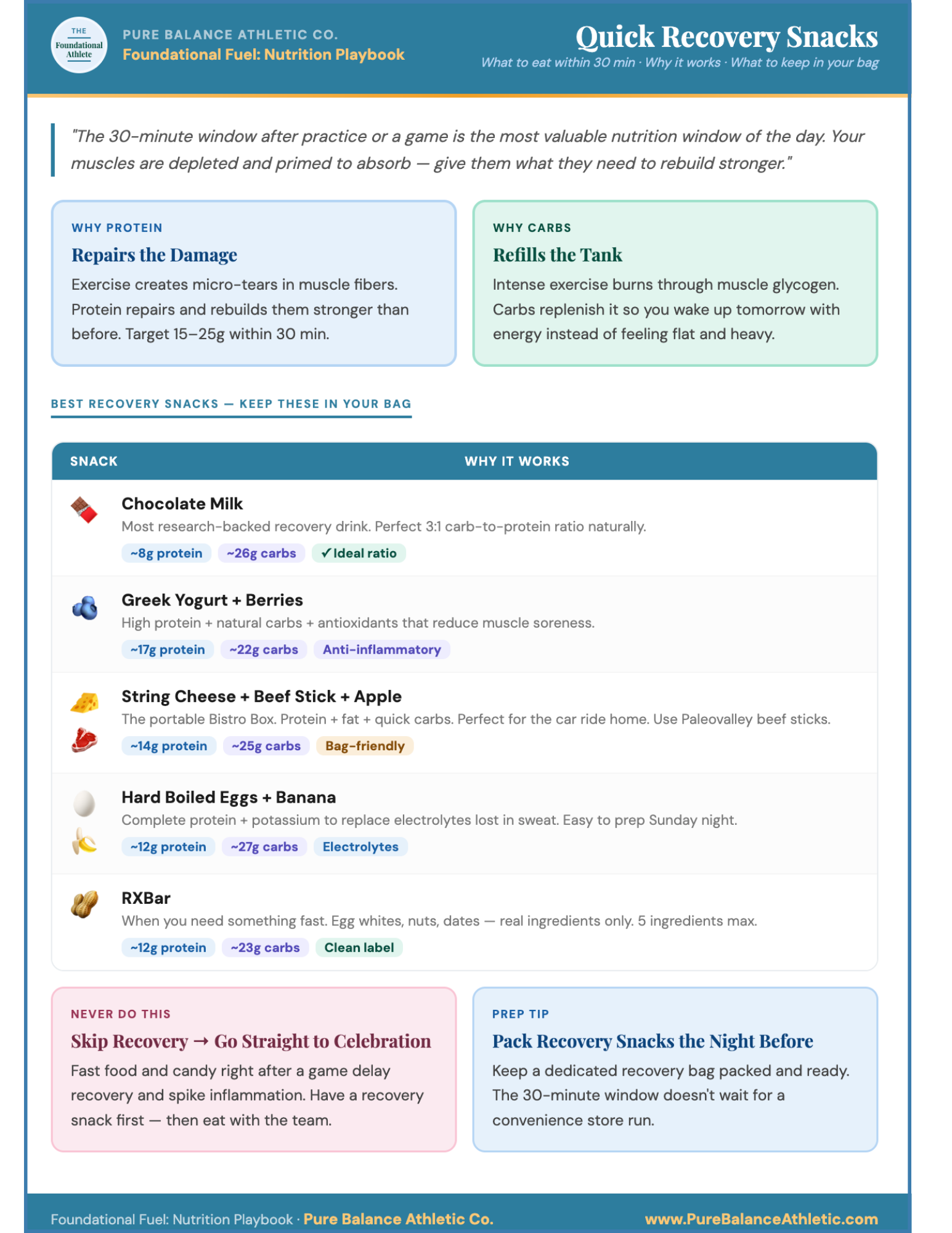
After 6–10 hours of competition including multiple high-intensity swims, warm-up sets, and cool-downs, muscle glycogen is significantly depleted and micro-damage exists from explosive efforts. The 30-minute post-meet window is when muscles are most receptive to nutrition. Missing it means a longer recovery timeline — critical for swimmers who train again the next day.
Protein + carbs now
Stroke-by-stroke nutrition strategy
Freestyle — 50m to 1500m
Energy demands
50/100m: Almost entirely ATP-PC and anaerobic glycolysis. Full glycogen stores critical. GI sensitivity moderate.
200m+: Aerobic + anaerobic mix. Highest GI risk in distance freestyle — nothing in last 60 min before race.
Pre-race strategy
Banana or dates 30–45 min before sprint events. Water and electrolytes only in final 60 min for 200m+.
Breaststroke — 50m to 200m
Energy demands
Highest energy cost per lap of all four strokes due to the kick mechanics and recovery position. Requires maximum glycogen loading the night before.
Most cramping-prone stroke — potassium (banana, electrolytes) is especially critical.
Pre-race strategy
Ensure the night-before dinner was high-carb. Banana 45 min before race. Buoy drops in water throughout the day.
Butterfly — 50m to 200m
Energy demands
Most explosive stroke. Demands peak power output from the first stroke. Any food in the stomach at race time will impair performance and increase GI distress risk.
200m butterfly is one of the most physically demanding events in all of competitive swimming.
Pre-race strategy
Keep stomach completely light for 45+ min before event. Fast carbs only — banana or a few dates maximum. Never eat a snack right before fly.
Individual Medley — 100m to 400m
Energy demands
Highest total energy demand of any single event — requires all four strokes and transitions between anaerobic and aerobic systems mid-race.
400 IM is one of the most grueling events in swimming. Glycogen must be fully loaded the night before.
Pre-race strategy
Ensure plenty of carbs between earlier events and the IM. Banana 45 min out. Keep stomach light in final 45 min before race.
🏆 Championship meets — the prelims to finals nutrition window
Immediately after prelims
Recovery fuel within 30 min
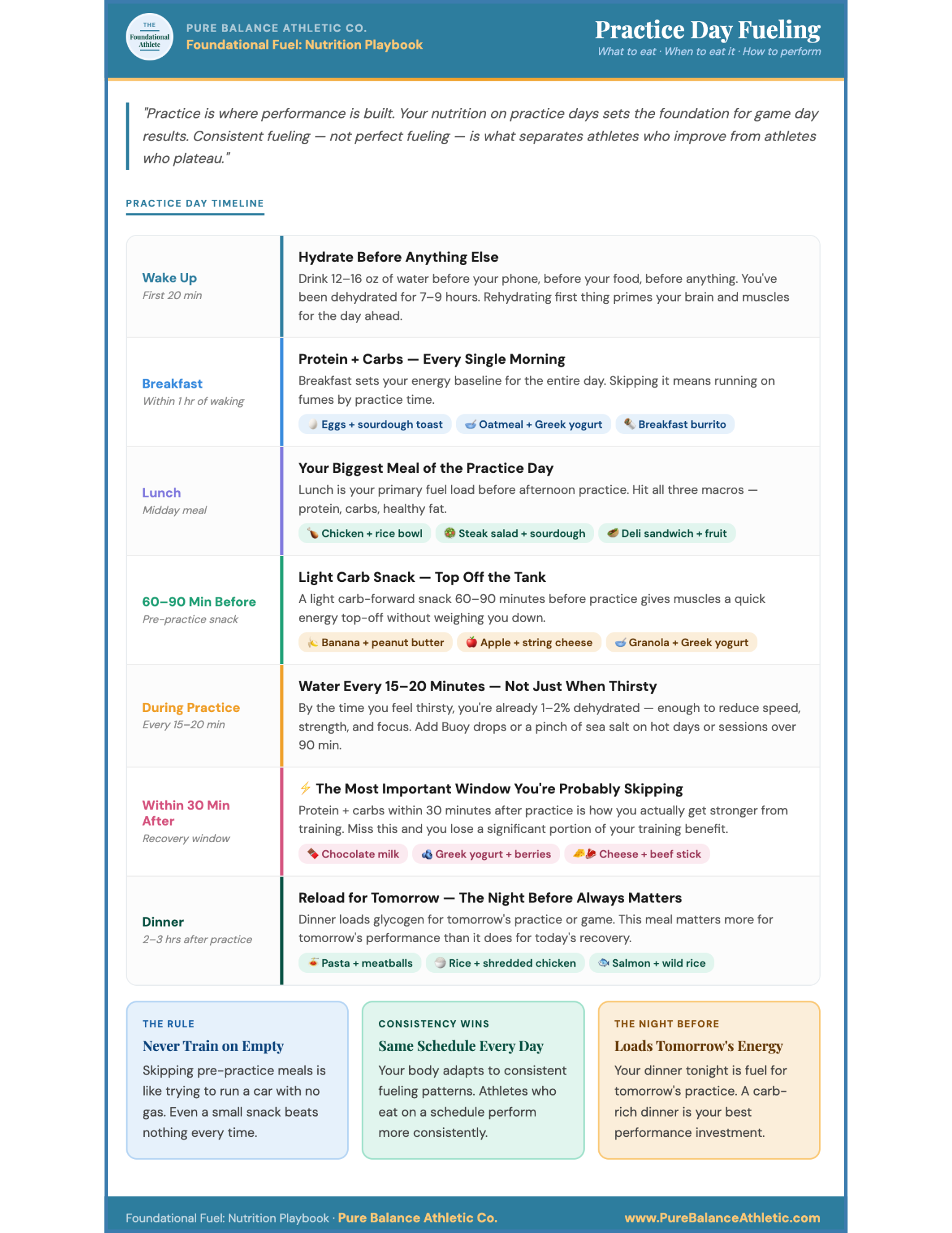
Hard-boiled eggs + banana, beef stick + fruit, or Greek yogurt + granola. Starts glycogen restoration and muscle repair before the finals window begins.
2 hours before finals warm-up
Full between-session meal
Rice + chicken, or pasta + protein, or eggs + sourdough. This is the most important nutrition decision of a championship day. Swimmers who eat a real meal here consistently swim faster in finals.
During finals warm-up gap
Light carbs + hydration only
Banana or dates 30–45 min before first finals event. Water + Buoy drops continuously. Nothing heavy once finals warm-up begins.
What to pack and why — every approved food explained
| Food | When | Why it works for swimming | Macros |
|---|---|---|---|
Rice + chicken + veggies Lundberg · Organic Valley | Night before | Rice is the most efficient glycogen-loading carbohydrate — no bloating, rapid muscle storage, highly digestible. Chicken provides leucine for overnight muscle preparation. This combination is the most evidence-based pre-meet dinner available for competitive swimmers. | High carbsProtein |
Eggs + sourdough + banana Organic Valley · Prager Bros | Morning of | Choline from eggs directly supports the neuromuscular coordination required for precise stroke mechanics and turns. Sourdough's lower glycemic index prevents early energy crashes. Banana provides potassium critical for breaststroke cramp prevention and fast-acting glucose for the final top-off. | ProteinSlow + fast carbsElectrolytes |
Banana or medjool dates | 30–45 min pre-race | The fastest whole-food carbohydrate sources available. Digest quickly without GI risk. Bananas provide glucose + potassium simultaneously — addressing both energy and cramping risk in one food. Dates are even more concentrated and ideal for sprinters needing a final energy top-off before butterfly or sprint freestyle. | Fast carbsPotassium |
Beef stick + apple Paleovalley | 90+ min between events | Paleovalley grass-fed beef provides complete protein, zinc, and creatine — supporting the repeated phosphocreatine regeneration required between sprint events. Apple delivers natural fructose + glucose for dual-pathway energy. No refrigeration required poolside. Zero seed oils, nitrates, or additives. | Complete proteinNatural carbs |
Hard-boiled eggs + fruit Organic Valley | Between prelims & finals | Between championship sessions, the body needs complete protein to begin muscle repair AND fast carbohydrates to restock glycogen before finals warm-up. Eggs provide BV-100 protein with leucine to maximize the limited between-session recovery window. This combination is the single best between-session recovery food for competitive swimmers. | Complete proteinFast carbs |
Greek yogurt + granola Organic Valley · Purely Elizabeth | Between sessions or post-meet | Casein + whey protein blend from Greek yogurt extends amino acid delivery over 2–3 hours — ideal between a morning prelims and afternoon finals session. Probiotics support gut health after a day of chlorine exposure, which can irritate the GI system. Purely Elizabeth granola provides clean complex carbohydrates without seed oils or added sugar. | ProteinCarbsProbiotics |
Rice cakes + nut butter Lundberg | 60–90 min between events | Lundberg rice cakes are the most easily digestible whole food carbohydrate — no fiber load that could cause GI distress, no seed oils, minimal ingredients. Nut butter's fat and protein content slows glucose absorption appropriately for a longer gap between events. A staple between-event snack for competitive swimmers at all levels. | Slow carbsHealthy fat |
Hydration strategy — the invisible problem solved
✅ Approved hydration for a swim meet
💧
Water (48–64 oz for a full meet) — Drink between every event, warm-up, and cool-down. For indoor meets in warm natatoriums, increase to 64+ oz. Start the morning with 16 oz before leaving home.
🫧
Buoy electrolyte drops — Sodium, potassium, and magnesium lost through sweat and respiratory loss. Especially critical for breaststroke athletes who cramp frequently. Add to every water bottle from warm-up through finals.
🍋
Lemon + sea salt water — Natural electrolyte backup. Lemon provides vitamin C + flavor that encourages more drinking. Pinch of sea salt replaces sodium. Simple and effective for the second water bottle.
🍌
Potassium-rich foods — Bananas and dates throughout the day specifically address the cramp risk that dehydration and potassium depletion create — most acute in breaststroke kick and butterfly pullout mechanics.
🚫 What to avoid on meet day
⚡
Sports drinks (Gatorade, Powerade) — 34g added sugar creates glucose spike + crash. The crash typically hits in finals — when it matters most. Dyes and artificial flavoring increase GI sensitivity risk in competitive swimmers.
⚡
Energy drinks — Absolutely never for ages 10–17. Caffeine elevates anxiety and heart rate — the opposite of what swimmers need for relaxed, efficient stroke mechanics. Contraindicated for all competitive swimming events.
🥤
Soda at the meet — Carbonation causes GI distress during repeated physical effort and between warm-up sets. Sugar crash in the afternoon session is extremely common in swimmers who had a soda at lunch during a championship meet.
🚫
Waiting until thirsty — Thirst is masked by pool immersion. By the time a swimmer feels thirsty at a meet, meaningful dehydration has already occurred. Drinking must be on a schedule, not driven by sensation.
The science behind swim meet nutrition
Fluid loss in the pool — the research
Studies measuring sweat rate in competitive swimmers confirm fluid losses of 400–800ml per hour of activity — comparable to many land-based sports. Indoor pool environments with warm humid air increase respiratory moisture loss significantly. Research shows swimmers who maintain adequate hydration throughout a meet demonstrate better split consistency, faster turn execution, and lower RPE in finals.
Maughan RJ & Shirreffs SM, Sports Med 2010; Stachenfeld NS, Med Sci Sports 2008
Glycogen & sprint swimming performance
Sprint swimming (50–200m) relies primarily on phosphocreatine and muscle glycogen — there is no fat oxidation pathway available for these efforts. When glycogen is not fully loaded, peak power in the first 25m is reduced and fade rate increases. Research on competitive swimmers confirms that pre-competition carbohydrate loading meaningfully improves 100m and 200m times compared to normal dietary intake.
Burke LM et al., JOSPT 2011; Pyne DB et al., Int J Sport Nutr 2014
Between-session recovery — prelims to finals
Research on multi-session competition shows athletes who consume protein + carbohydrates within 30 minutes of prelims and again 2 hours before finals demonstrate significantly greater performance improvement in finals compared to those who eat ad-hoc or skip post-prelims nutrition. The between-session window is the single most impactful nutritional intervention available at a championship meet — and the most commonly neglected.
Ivy JL, Curr Sports Med Reports 2004; Beelen M et al., Int J Sport Nutr 2010
Choline, stroke mechanics & reaction time
Egg yolks are the richest dietary source of choline — the precursor to acetylcholine, the neurotransmitter governing precise motor control, muscle coordination, and reaction time. Competitive swimming demands microsecond-level precision in stroke mechanics, turns, and start reaction time. Adequate choline intake from eggs on meet day morning supports the neuromuscular precision that separates a drop-time from a best time.
Zeisel SH, FASEB J 2012; Poly C et al., AJCN 2011
Sample meet day nutrition schedule
| Time | Action | What to eat / drink | Parent notes |
|---|---|---|---|
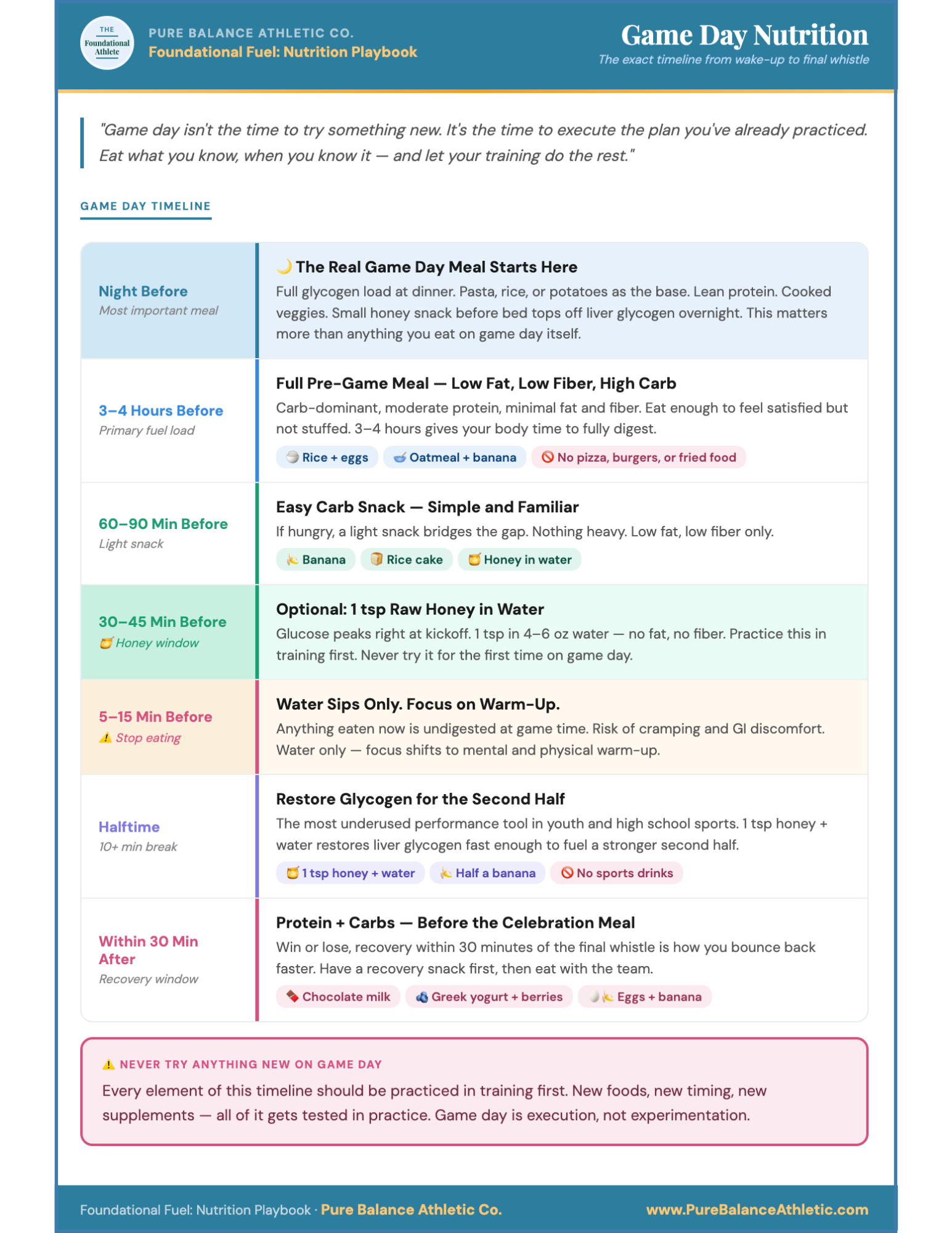
| Night before (dinner) | Glycogen load | Rice + chicken + veggies or pasta + ground beef + marinara. 16 oz water with dinner. | Single most important meal. Full portion — don't eat light due to nerves. |
| Night before (before bed) | Pre-hydrate + protein | 8–16 oz water. Optional Greek yogurt + granola for slow overnight protein delivery. | Sets up morning hydration and extends overnight amino acid availability. |
| Morning (2–3 hrs before warm-up) | Full breakfast | Eggs + sourdough + banana, or oatmeal + eggs + berries, or egg wrap. 16 oz water. | Time from warm-up, not first race. Swimmers often warm up 60–90 min before racing. |
| Arrival at meet | Fill water + electrolytes | Full 32 oz water bottle with Buoy drops. Begin sipping immediately from warm-up. | Don't wait until racing to start drinking. Pre-hydration starts at warm-up. |
| Between events (90+ min gaps) | Light refuel | Rice cakes + nut butter, cheese + grapes, or beef stick + apple. Continue water. | Eat at least 90 min before next race. Nothing heavy in final 45 min before event. |
| 30–45 min before each race | Fast carbs only | Banana or dates. Water + electrolytes only. No solid food in last 30 min before fly or distance events. | Lighter the closer to race time. GI risk highest in butterfly and distance events. |
| Within 30 min after prelims | Recovery + refuel | Hard-boiled eggs + banana, or beef stick + fruit. Drink 16 oz water immediately. | Championship meet critical window. This fuels the between-session recovery. |
| 2 hrs before finals warm-up | Between-session meal | Rice + chicken, eggs + sourdough, or pasta + protein. This is a full meal — not a snack. | Most important decision of a championship day. Don't let swimmer skip or eat light here. |
| Within 30 min post-meet | Full recovery | Greek yogurt + granola, hard-boiled eggs + fruit, or beef stick + banana + rice cakes. | Have this ready at the car. Recovery starts the moment the last race ends. |
Parent prep tips for meet day
Pack the night before — every meet
Swim meets often have early warm-up times (6–7am at championships). Packing food, filling water bottles, and preparing cold packs the night before removes every decision from the chaotic morning rush.
Get the heat sheet in advance
Knowing your swimmer's events and approximate times allows you to plan exactly when they should eat, what size snack is appropriate, and whether they have a gap long enough for a real meal between events.
Cold pack is non-negotiable
A full-day swim meet in a warm natatorium requires a proper insulated bag with cold packs. Hard-boiled eggs, Greek yogurt, and cheese must be kept cold from home to meet. Food safety at an 8-hour meet is a real concern.
Championship meets require a different plan
Prelims-finals meets require a full between-session meal — not just a snack. Plan for and prepare this meal specifically. Many parents bring a small cooler to championships with a complete between-session meal ready for their swimmer to eat poolside before finals.
Remind swimmers to drink on a schedule
Before the meet begins, remind your swimmer to drink after every event whether or not they feel thirsty. The sensation of being wet in the pool overrides thirst signals — drinking must be intentional and scheduled, not reactive.
Always pack extra bananas
Bananas are the most versatile meet-day food for swimmers. Pre-race carbs, mid-meet potassium for cramp prevention, post-race quick recovery — pack 3–4 per swimmer per day. They need no refrigeration and survive a full day in a swim bag.
Common parent questions
My swimmer gets nervous and can't eat before a meet. What do we do?
Pre-meet nausea is one of the most common challenges in competitive swimming — especially at championship meets. The solution is to eat earlier (2.5–3 hours before warm-up rather than 2), choose smaller, easier-to-digest foods (banana + RXBar rather than a full egg breakfast), and try liquid options if solid food is impossible (a smoothie with banana, yogurt, and granola can work when solids don't). Something is always better than fasted racing — a depleted swimmer in a 200 IM is at a significant disadvantage regardless of their fitness level.
Should my swimmer eat differently the day before a championship vs. a regular dual meet?
Yes. For a regular dual meet, a normal dinner with good carbs and protein is sufficient. For a championship meet (particularly if prelims and finals are the same day), the night-before dinner should be your swimmer's highest carbohydrate meal of the entire week — a large portion of rice, pasta, or potato with quality protein. Some elite programs also add a carbohydrate snack before bed (granola + yogurt or rice cakes + nut butter) for maximum glycogen loading on championship nights.
My breaststroker cramps constantly in races. Is that a nutrition issue?
Very likely yes, at least partially. Cramping in competitive swimming is most commonly caused by a combination of dehydration, potassium depletion, and magnesium deficiency. Breaststroke's kick mechanics place the highest repetitive demand on the calf and foot muscles of any stroke — exactly where cramps most often occur. The protocol: Buoy electrolyte drops in every water bottle all day, 2–3 bananas across the meet, and magnesium-rich foods (pumpkin seeds, dark chocolate) the night before. If cramping persists, consider a broader electrolyte and micronutrient assessment.
My swimmer's times are great in prelims but always worse in finals. Could nutrition be causing this?
This is one of the most tell-tale signs of poor between-session nutrition. When swimmers go slower in finals despite better rest, the most common culprits are: insufficient carbohydrate intake between sessions (failing to restock glycogen), inadequate hydration between sessions (mild dehydration compounds across the day), and poor pre-finals meal timing (eating too close to finals warm-up causing GI discomfort). Review what your swimmer ate and drank between prelims and finals specifically — in most cases, the nutrition strategy there is the answer to the performance gap.
"The race is won at dinner the night before, at breakfast the morning of, and in the 2 hours between prelims and finals. Fuel those windows and the rest takes care of itself."
Key references
Maughan RJ & Shirreffs SM (2010). Dehydration and rehydration in competitive sport. Sports Medicine. · Burke LM et al. (2011). Carbohydrates for training and competition. JOSPT. · Pyne DB et al. (2014). Nutrition and swimmer performance. Int J Sport Nutr Exercise Metab. · Ivy JL (2004). Regulation of muscle glycogen repletion, muscle protein synthesis and repair following exercise. Current Sports Medicine Reports. · Zeisel SH (2012). A brief history of choline. FASEB Journal. · Beelen M et al. (2010). Nutritional strategies to promote post-exercise recovery. Int J Sport Nutr Exercise Metab.

Nutrition Quick Guides
Explore these additional resources for more insights.