Parent Guide · Softball · Ages 14–18 · High School & Travel Ball
Game Day Nutrition — The Why Behind Every Choice
The Foundational Athlete · Pure Balance Athletic Co.
Why softball game day nutrition demands serious attention
Softball is a sport of explosive bursts, sustained mental focus, and physical demands that vary dramatically by position — all across 7 innings that can stretch to 3+ hours on a tournament day. Every at-bat requires split-second pitch recognition running on blood glucose and choline. Every throw across the diamond runs on glycogen loaded the night before. The pitcher's arm endurance in the 6th inning depends on omega-3s consumed at dinner. The catcher squatting for 7 innings in full gear in summer heat loses more fluid than any other player on the field. What your athlete eats — and when — is not a detail. It is the system that makes everything else work.
What makes softball nutritionally unique
Explosive stop-and-start every play
Unlike continuous-effort sports, softball demands maximal explosive output on every single play — every pitch, every swing, every throw and sprint — followed by a complete reset. This pattern burns through glycogen differently than endurance sports, making the night-before dinner the single most impactful nutritional decision of the week. Every explosive burst draws from the same tank loaded at dinner the night before.
Cognitive demands on every pitch
Pitch recognition, defensive positioning, stolen base reads, and real-time game management all require sustained cognitive performance across 7 innings. Blood glucose depletion impairs these decisions before it impairs physical performance. The error on a routine play in the 6th inning, the strikeout on a pitch the batter was sitting on — these are often blood glucose events, not skill failures. Between-inning nutrition directly addresses this.
Position-specific demands are extreme
No sport has more dramatic nutritional differences between positions than softball. A pitcher's arm recovery, a catcher's heat management in full gear, and an outfielder's blood glucose maintenance during long idle stretches all require fundamentally different nutrition strategies. A single generic game day plan does not address these differences — which is why the Foundational Athlete program accounts for every position specifically.
The four nutrition windows of a softball game day
🌙Night Before
Dinner
Glycogen stored during sleep fuels first-inning explosiveness and sustains every at-bat through the final out. A high-carbohydrate dinner with quality protein is the most impactful nutrition decision of the entire game day cycle. Missing it means starting already behind.
Max carb + protein load
🌅Morning Of
2–3 hrs before
Tops off glycogen and provides choline for pitch recognition and reaction time. Eating too close to game time causes GI discomfort during explosive play. High-sugar breakfasts create a crash that hits in the 3rd inning. Eat 2–3 hours before first pitch — not before warm-up.
Real food + slow carbs
🥎During Game
Every inning
Water and electrolytes at every half inning are non-negotiable. Fast carbohydrates between innings maintain blood glucose for sharp decision-making and reaction time in the late innings. Dehydration and glucose depletion both show up as mental errors before physical fatigue.
Hydrate + fast carbs
🏁Post-Game
Within 30 min
GLUT-4 receptors are most active in the 30 minutes after the final out. Complete protein plus fast-acting carbohydrates consumed in this window initiate muscle repair and glycogen restoration. For pitchers, this window also begins arm recovery. Missing it extends soreness and impairs next-day training.
Protein + carbs now
Position-by-position nutrition strategy
Pitcher — arm recovery is a nutrition event
The nutritional demands no other position has
Rotator cuff and forearm stress accumulates with every windmill delivery. Over a full start — 80–120+ pitches — the cumulative micro-damage to arm tissue is significant. Omega-3 fatty acids from salmon consumed the night before a start measurably reduce the inflammatory response in shoulder and forearm musculature.
Pitch command across 100+ pitches depends on sustained neuromuscular precision — which requires choline (from eggs) and consistent blood glucose. Command that deteriorates in the 5th and 6th innings is almost always a nutrition problem before it becomes a fatigue problem.
Post-start recovery starts within 20 minutes of the final pitch — not at dinner. Complete protein initiates rotator cuff tissue repair. Tart cherries reduce arm soreness markers by up to 22%. This recovery window is specific to pitchers and has no equivalent for any other position.
Electrolyte depletion mid-outing causes forearm cramping that kills velocity and command. Buoy drops in the water bottle between every inning prevent this. Non-negotiable for pitchers on warm game days.
Catcher — highest hydration demand on the field
Why catchers need more fluid than any other position
Full gear in summer heat traps body heat and elevates sweat rate 40–60% above equivalent effort without equipment. A catcher in a July tournament loses significantly more fluid per inning than any field player — and often has fewer natural hydration breaks because they set up behind the plate on every pitch.
Explosive squat-to-throw mechanics on every pitch draw from the same phosphocreatine and glycogen stores as a sprint. Over 7 innings and 100+ pitches, this cumulative explosive demand is as high as any position in any sport. Creatine from red meat at dinner directly supports this.
Cognitive load behind the plate — calling pitches, reading hitters, managing the defense — requires sustained decision-making quality across the full game. Blood glucose depletion shows up in catchers as poor pitch calls and missed reads before physical fatigue becomes apparent.
Pre-game pre-hydration before gear goes on changes the entire game. Drink 16 oz of water at breakfast — before the drive, before the warm-up, before gear. This is the single most impactful catcher-specific nutrition intervention.
Infield — reaction speed is a nutrition outcome
Why infield errors in the late innings are often nutrition failures
Hundreds of micro-explosive movements per game — lateral slides, diving stops, explosive throws across the diamond — each drawing from glycogen and phosphocreatine. Infielders move more frequently in bursts than their total distance suggests.
Reaction time at the plate and in the field runs on blood glucose and choline from breakfast eggs. The shortstop who boots a routine grounder in the 6th inning on a play they make 100 times in practice is almost always experiencing blood glucose depletion — not a loss of skill.
Between-inning banana is the infield's most important in-game nutrition intervention. Fast carbs + potassium consumed consistently across the game maintain first-step speed and defensive reaction through the final out.
Outfield — blood glucose drops during idle stretches
The outfield-specific nutrition challenge no one talks about
Long idle periods followed by explosive all-out sprints create a unique nutritional challenge. During extended time without a ball hit to the outfield, blood glucose declines passively — meaning the outfielder who needs to make a full sprint to the gap in the 7th inning may be doing so already partially depleted.
Eating between innings even when it's quiet is non-optional for outfielders. The dropped fly ball, the misread on a line drive, the slow first step — these are predictable outcomes of not eating between innings during low-activity stretches. The banana eaten in the 3rd inning protects the play in the 7th.
Sun exposure dehydrates outfielders faster than players in the infield shade. Add Buoy drops to every water bottle and drink at every half inning — the outfielder standing in direct sun for 2+ hours loses significantly more fluid than their visible sweat suggests.
⚾ The pitcher's arm recovery protocol — what parents need to know
Night before start
Salmon + rice + veggies
EPA and DHA from salmon reduce the inflammatory response in shoulder and forearm tissue that begins accumulating on pitch 1. This is the most impactful pre-start meal a pitcher can eat.
Within 20 min of final pitch
Eggs + banana immediately
Complete protein initiates rotator cuff tissue repair at the point of maximum GLUT-4 sensitivity. This is more important than any post-game icing protocol for long-term arm health.
Post-game dinner
Salmon again + tart cherries
Omega-3s consumed within hours of pitching measurably reduce next-day arm soreness. Tart cherry anthocyanins reduce post-exercise muscle damage markers by up to 22% in research on throwing athletes.
What to pack and why — every approved food explained
| Food | When | Why it works for softball | Macros |
|---|---|---|---|
Rice + chicken + veggies Lundberg · Organic Valley | Night before | Rice is the most efficient glycogen-loading carbohydrate — clean digestion, rapid muscle storage, zero bloating. For softball's explosive demands across 7 innings, maximum glycogen loading the night before is the highest-impact nutrition decision of the week. Chicken provides leucine for overnight muscle preparation. | High carbsProtein |
Salmon Safe Catch | Night before start (pitchers) + post-game | EPA and DHA from wild salmon directly reduce rotator cuff and forearm inflammation for pitchers. For all positions, omega-3s reduce training-induced muscle damage and support overnight recovery. Safe Catch is tested for mercury — important for female athletes consuming fish regularly. | Complete proteinOmega-3s |
Eggs + sourdough + banana Organic Valley · Prager Bros | Morning of game | Choline from eggs directly supports the acetylcholine pathway governing pitch recognition speed, reaction time at the plate, and glove-to-throw neuromuscular coordination. Sourdough's lower glycemic index prevents the mid-game crash from high-sugar breakfasts. Banana adds potassium for cramp prevention across the full game. | ProteinSlow + fast carbsElectrolytes |
Banana between innings | During game — every position | The single most important in-game food for every softball position. Glucose + fructose dual-pathway energy restores blood glucose that has declined since breakfast. Potassium prevents the late-game leg and forearm cramping that ends performances. Every position, every game, every inning gap where food is possible. | Fast carbsPotassium |
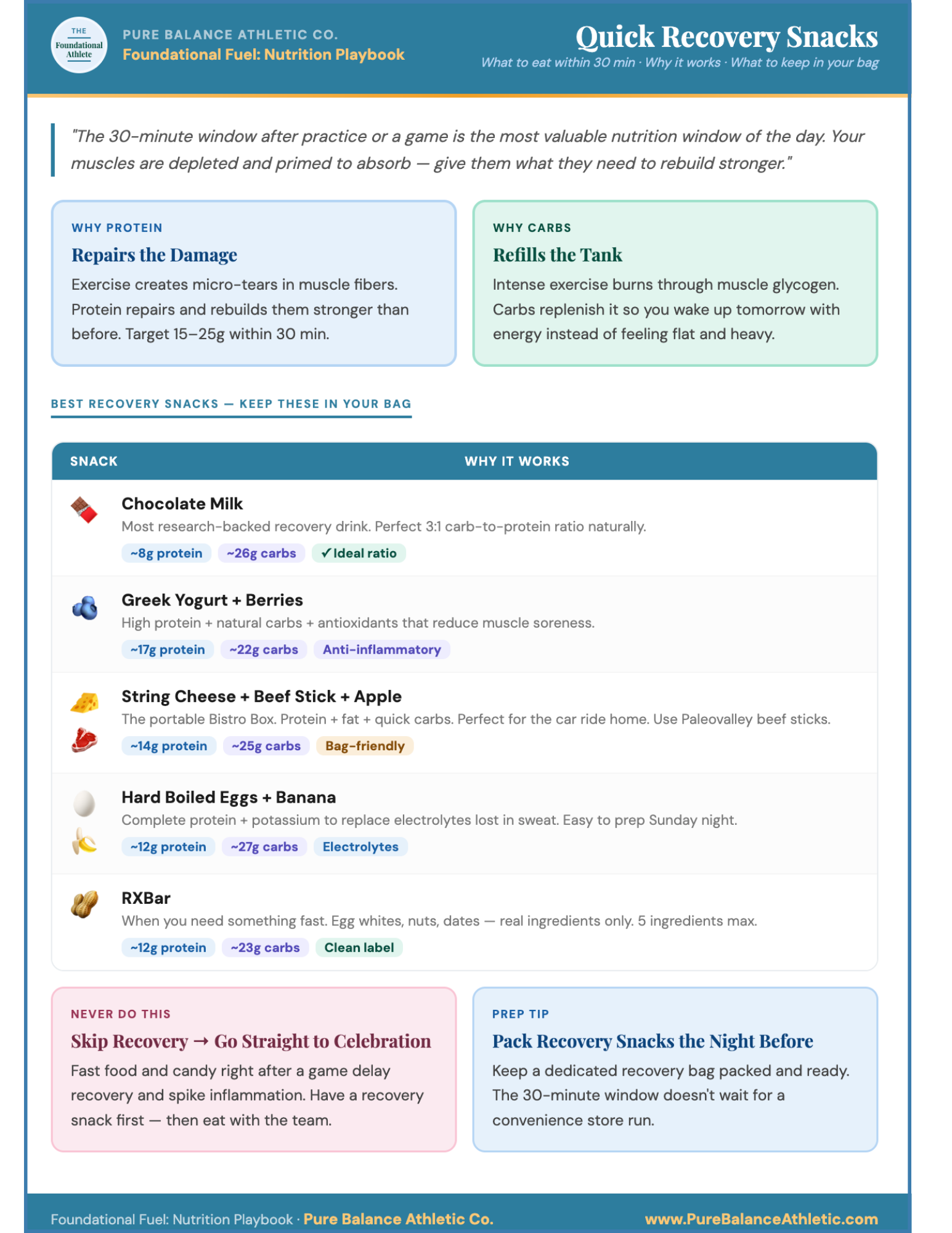
Hard-boiled eggs + banana Organic Valley | Post-game (within 30 min) | BV-100 complete protein from eggs initiates muscle protein synthesis at the point of maximum GLUT-4 receptor activity. For pitchers specifically, this is the arm recovery meal that matters most. Banana restores glycogen. Pack it in the bag before first pitch — this meal doesn't wait for the team dinner. | Complete proteinFast carbs |
Beef sticks + apple slices Paleovalley | Post-game or between games | Paleovalley grass-fed beef provides complete protein, natural creatine, and heme iron — particularly important for female softball athletes with higher iron deficiency risk. Apple delivers natural carbohydrates for glycogen restoration. No refrigeration needed. Tournament-bag essential. | Complete proteinNatural carbsIron |
Buoy electrolyte drops Buoy | Every water bottle — every game | Zero sugar, zero dye — replaces sodium, potassium, and magnesium lost through sweat with precision. For catchers: non-negotiable. For pitchers: prevents mid-outing forearm cramping. For outfielders in direct sun: prevents the late-game energy wall. The only approved electrolyte supplement in this program — no Gatorade, no sports drinks. | Sodium · Potassium · Magnesium |
Tart cherries | Post-start (pitchers) + post-game | Anthocyanin compounds in tart cherries reduce oxidative muscle damage markers by up to 22% in research on throwing athletes. Natural melatonin precursors also support sleep quality — critical for arm recovery after a full pitching start. One of the most evidence-backed recovery foods for overhead throwing athletes. | Anti-inflammatoryNatural carbs |
Hydration strategy for game day
✅ Approved hydration for game day
💧
Water (40–64 oz depending on conditions and position) — Catchers: minimum 64 oz on warm days. All positions: start drinking before arrival. Teach your athlete to sip at every half inning — not wait until they're thirsty.
🫧
Buoy electrolyte drops — In every water bottle. Replaces sodium, potassium, and magnesium lost in sweat. Zero sugar. Critical on warm days, turf fields in direct sun, and for catchers in full gear.
🍋
Lemon + sea salt water — Natural electrolyte backup for a second bottle. Easy to prep. Half a lemon squeezed into water with a pinch of sea salt provides sodium and vitamin C.
🍌
Potassium through food — Bananas and orange slices address the potassium depletion behind late-game cramping in catchers, pitchers, and infielders. Eat them — don't rely on water alone for electrolyte replacement.
🚫 What to avoid on game day
⚡
Sports drinks (Gatorade, Powerade) — 34g added sugar creates a glucose spike and crash that typically hits in the 3rd or 4th inning. Artificial dyes and high fructose corn syrup are unnecessary and counter to the Three Evils framework.
⚡
Energy drinks — Never on game day for ages 14–18. Caffeine elevates anxiety and impairs the fine motor coordination behind pitch recognition, pitch command, and defensive reads. Contraindicated for every softball position.
🚿
Sunflower seeds — The dugout standard that works against performance. Extremely high sodium without electrolyte balance, and the shell handling creates GI distraction and dryness during a game. Replace with Buoy drops for the sodium athletes are seeking from seeds.
🍔
Fast food before games — High fat slows gastric emptying significantly. A pre-game fast food stop causes GI distress during explosive play. One of the most preventable performance mistakes in travel softball.
👧 Female athlete considerations — what every softball parent should know
Iron Deficiency — the most common hidden performance problem
Iron deficiency is the most prevalent micronutrient deficiency in female athletes and directly impairs oxygen delivery to working muscles — reducing sprint speed, throwing endurance, and recovery capacity. Female softball players ages 14–18 are at elevated risk due to menstrual losses combined with training demand. Red meat and eggs — both central to this program — are the top dietary heme iron sources. If your athlete shows chronic fatigue, frequent illness, or declining performance despite consistent training and sleep, iron status should be the first thing evaluated.
RED-S — Relative Energy Deficiency in Sport
RED-S is a clinically recognized condition where training and competition demands consistently exceed caloric intake. In female softball players, it presents as stress fractures (especially in the feet and shins from repetitive throwing mechanics and running), frequent illness, irregular or absent menstrual cycles, and performance plateaus despite consistent training. Caloric restriction before or during the competitive season is never appropriate for athletes ages 14–18. The foods in this program are specifically chosen to fuel performance — not to restrict it. If you observe these signs in your athlete, consult a sports medicine professional or registered dietitian.
🏆 Tournament & doubleheader protocol
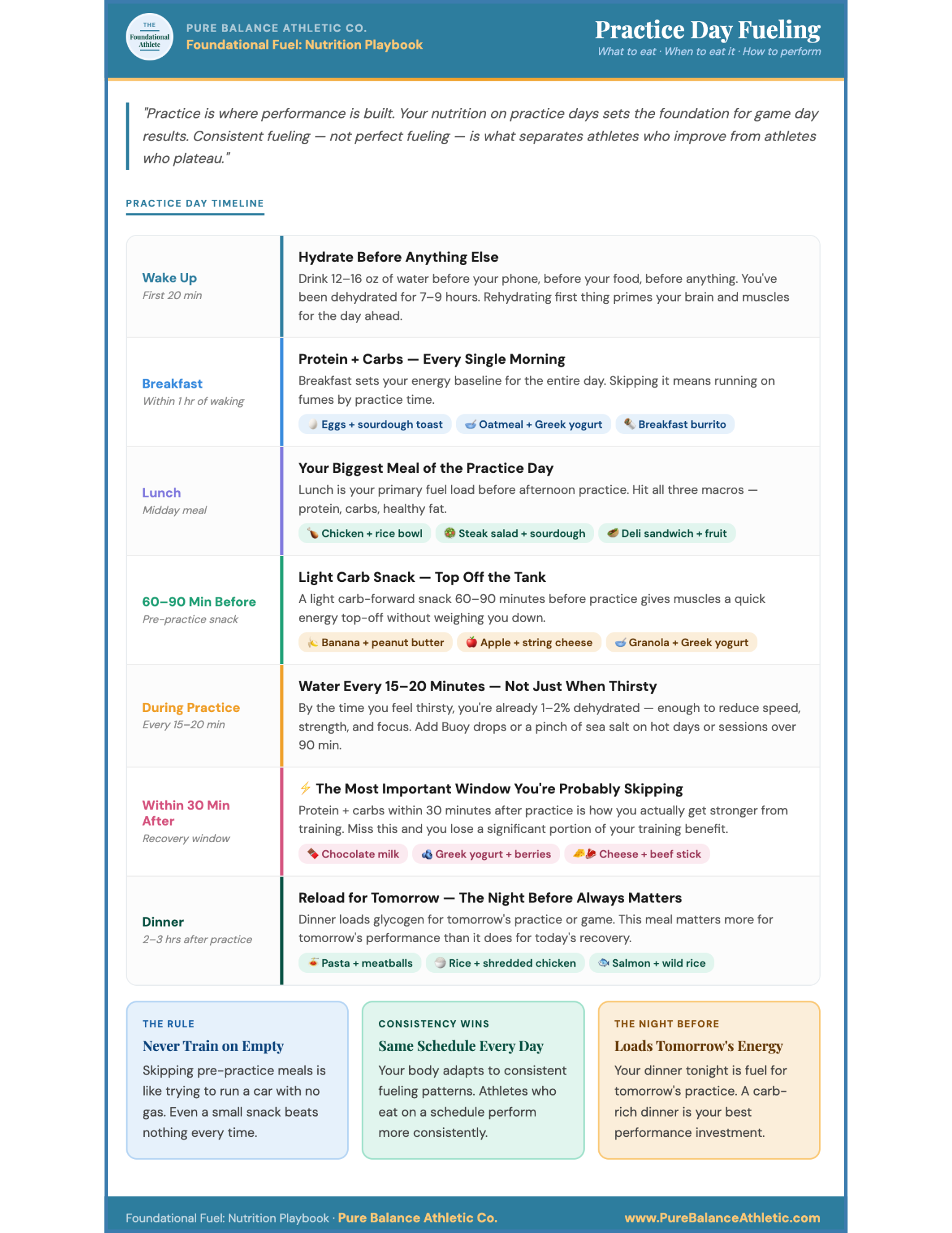
Within 30 min of game 1
Protein + fast carbs immediately
Hard-boiled eggs + banana, or beef stick + fruit. Recovery starts at the final out — not at the hotel. Pitchers: this window is your arm recovery window.
Between games (60+ min gap)
Real food + full hydration reset
Greek yogurt + granola, rice cakes + nut butter, or a full portable meal. Drink a full bottle with Buoy drops. This meal determines game 2 performance — not just game 1 recovery.
Before game 2 warm-up
Light top-off + final hydration
Banana or 2–3 dates 45–60 min before game 2 first pitch. Small water sip before warm-up. Nothing heavy — the recovery meal is already doing its work.
The science behind softball game day nutrition
Glycogen depletion across 7 innings
Research on intermittent explosive sports consistently shows that muscle glycogen declines across a game when not supported by pre-game loading and between-inning carbohydrates. For softball specifically, the explosive demands of every at-bat, throw, and defensive movement draw from the same phosphocreatine and glycogen system. Late-inning performance decline is a predictable physiological outcome of inadequate fueling — not a fitness or focus problem.
Burke et al., JOSPT 2011; Glaister M, Sports Medicine 2005
Choline, reaction time, and pitch recognition
Choline from eggs is a precursor to acetylcholine — the primary neurotransmitter governing rapid motor control, hand-eye coordination, and cognitive processing under physical demand. Studies show improved reaction time and sustained motor precision in athletes with adequate choline intake. For softball specifically, the 0.4-second window to recognize and respond to a pitch is a neurotransmitter event as much as it is a skill event.
Zeisel SH, Nutrition Reviews 2006; Cohen BM et al., Am J Psychiatry 1980
Omega-3s and pitcher arm recovery
EPA and DHA from fatty fish directly modulate the inflammatory cascade triggered by repetitive overhead throwing. Research on baseball and softball pitchers documents reduced post-outing arm soreness and faster return-to-performance with consistent omega-3 intake. Tart cherry anthocyanins reduce post-exercise muscle damage markers by up to 22% — making the pitcher's post-start meal one of the most evidence-backed nutrition interventions in youth sports.
Mickleborough TD, Sports Medicine 2013; Howatson G et al., Br J Sports Med 2010
Catcher dehydration in full gear
Research on athletes in protective equipment demonstrates sweat rates 40–60% higher than equivalent effort without gear, due to impaired evaporative cooling. Catchers wearing chest protectors, leg guards, and helmets in summer conditions face heat accumulation that significantly exceeds what their physical exertion alone would produce. Pre-game hydration before gear goes on is the most effective single intervention for catcher performance maintenance across a full game or tournament day.
Maughan & Shirreffs, Sports Medicine 2010; Montain SJ et al., J Appl Physiol 1992
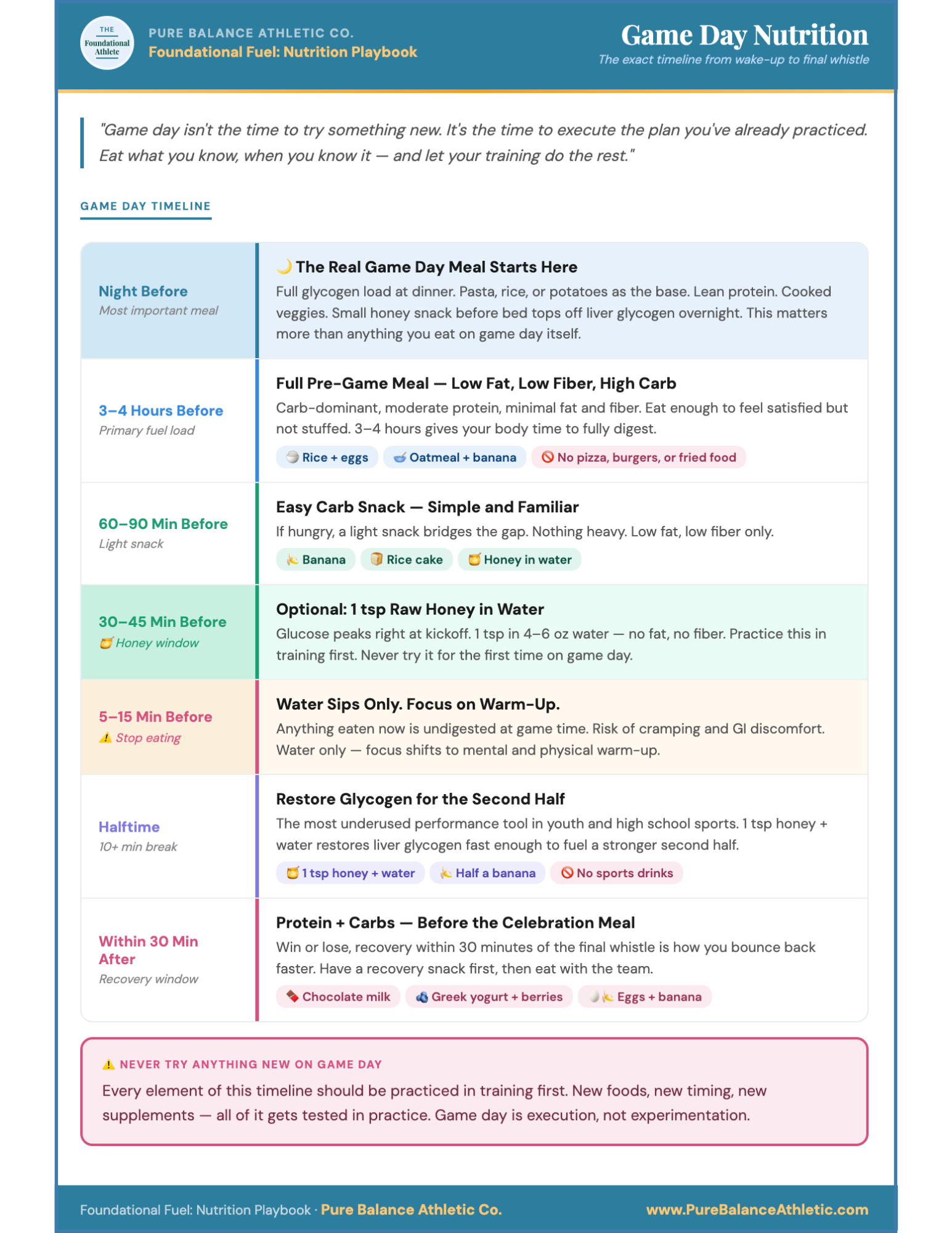
Sample game day nutrition schedule
| Time | Action | What to eat / drink | Parent notes |
|---|---|---|---|
| Night before (dinner) | Glycogen load | Rice + chicken + veggies, or pasta + ground beef + marinara. Pitchers: add salmon. 16 oz water with dinner. | Most important meal. Full portions — especially for pitchers and catchers. |
| Morning (2–3 hrs before) | Full breakfast | Eggs + sourdough + banana, or oatmeal + eggs + berries, or egg wrap. 16 oz water. | Non-negotiable. Skipping breakfast = running out of fuel in the 5th inning. |
| Arrival / warm-up | Fill water + electrolytes | Full bottle with Buoy drops before first pitch. Catchers: extra 8 oz before gear goes on. | Pre-hydration before gear changes the entire game for catchers. |
| Every half inning (in-game) | Sip water | 4–6 oz water at every half inning break. Every position, every inning, every game. | Teach this as a routine, not an option. Dehydration = errors before thirst. |
| Innings 2–4 (mid-game) | Fast carbs | Banana, orange slices, or 2–3 dates between innings. Outfielders especially — eat even when it's quiet. | The banana in the 3rd inning protects the play in the 7th. |
| Within 30 min post-game | Recovery | Hard-boiled eggs + banana, beef stick + fruit. Pitchers: tart cherries in this window too. | Have this ready in the bag. Recovery doesn't wait for the team dinner. |
| Post-game dinner | Full recovery meal | Salmon + rice + veggies (pitchers especially). Protein + carbs + vegetables for all positions. | Pitchers: salmon at dinner is the arm recovery meal. Don't substitute. |
Parent prep tips for game day
Pack the bag the night before
Water bottles, Buoy drops, banana, hard-boiled eggs, beef sticks, and a cold pack — all packed the evening before. Tournament morning chaos leads to poor food choices. Remove every decision in advance.
Pitcher families: salmon twice
Salmon the night before the start AND at post-game dinner is the arm recovery protocol. It requires planning — Safe Catch canned salmon works for the post-game meal when fresh isn't available. Make it a non-negotiable part of the starting routine.
Hard-boil eggs the night before
Recovery food should be ready before the game starts. Boil a batch of eggs the evening before, refrigerate, and pack them in the bag with a cold pack. The 30-minute post-game window doesn't allow for prep — it requires readiness.
Cold pack is non-negotiable
A full tournament day in summer heat requires a proper insulated bag with cold packs. Eggs, yogurt, and cheese must stay cold. Food safety is as important as food quality when games run from 8am to 6pm.
Pack extras for doubleheaders
A single game bag covers one game. A tournament bag needs double the food — 2 bananas, 2 beef sticks, extra water, and a between-game meal. Plan for the full day, not just the first game.
Brief your athlete before the day
Before every tournament: walk through the eating plan. Which games, what gaps, what to eat when. One five-minute conversation prevents 8 hours of missed nutrition windows. Especially important for pitchers — arm recovery is a scheduled event, not an afterthought.
Common parent questions
My pitcher's velocity drops significantly in the 5th and 6th innings. Is that a nutrition issue?
Velocity drop in late innings is almost always a combination of fatigue and nutrition — and nutrition is the more immediately addressable factor. The specific mechanisms: glycogen depletion reduces the explosive hip drive behind pitch velocity; electrolyte depletion (particularly potassium) causes forearm cramping that impairs arm acceleration; and blood glucose decline reduces the neuromuscular precision behind arm path consistency. The protocol is night-before salmon for anti-inflammatory support, eggs at breakfast for choline and complete protein, banana between innings starting in the 3rd, and Buoy drops in every water bottle. If velocity still drops with this protocol in place, the next step is a broader assessment of total caloric intake across the training week.
My catcher comes home exhausted after every tournament day. Is that normal?
Post-tournament exhaustion in catchers is common but not inevitable — and it's heavily nutrition-dependent. Catchers in full gear on warm days experience heat stress and fluid loss that exceeds what most parents realize. The specific protocol for catchers: 16 oz water at breakfast before gear goes on, Buoy drops in every water bottle throughout, banana by the 3rd inning of every game, 8 oz water immediately after each game before food, and a proper between-game meal on tournament days. Athletes who follow this consistently report significantly better energy at the end of tournament days within the first tournament where the full protocol is in place.
My daughter says she's not hungry before early morning games. What do we do?
Pre-game appetite suppression from adrenaline is common in female athletes. The solution is timing and food choice — not skipping. Move breakfast to 2.5–3 hours before first pitch, reduce portion size, and choose lower-fiber options: sourdough toast + banana + 1–2 eggs rather than a full oatmeal bowl. Liquid options work well when solids are difficult: a small banana + Greek yogurt smoothie delivers carbs and protein in a tolerable form. Fasting into a softball game produces the exact outcomes parents want to avoid — 5th-inning fatigue, poor at-bats, and slow reactions in the field.
What's the difference between a regular season game and a tournament weekend nutritionally?
A single regular season game requires: night-before dinner, pre-game breakfast, in-game hydration, and post-game recovery snack. A tournament weekend requires all of that plus: double the food quantity, a between-game recovery protocol for every gap, a full cold-storage system, pre-planning against the concession stand, and position-specific adjustments — particularly for pitchers who may start multiple games and catchers who play through every inning of every game. The foods are the same. The planning, quantity, and between-game discipline are what change. Plan tournament nutrition the same way you plan tournament travel logistics — in advance, with specifics, not on the fly.
"The pitcher who has command in the 7th inning ate salmon last night. The cleanup hitter who drives in the go-ahead run had eggs for breakfast and a banana in the 4th. Championship softball is built at the dinner table — not just on the diamond."
Key references
Burke LM et al. (2011). Carbohydrates for training and competition. JOSPT. · Mickleborough TD (2013). Omega-3 polyunsaturated fatty acids in physical performance optimization. Int J Sport Nutr Exerc Metab. · Howatson G et al. (2010). Influence of tart cherry juice on indices of recovery following marathon running. Scand J Med Sci Sports. · Zeisel SH (2006). Choline: critical role during fetal development and dietary requirements in adults. Annu Rev Nutr. · Maughan RJ & Shirreffs SM (2010). Dehydration and rehydration in competitive sport. Scand J Med Sci Sports. · Mountjoy M et al. (2014). IOC consensus statement: Relative Energy Deficiency in Sport. Br J Sports Med.

Nutrition Quick Guides
Explore these additional resources for more insights.