⚾

Parent Guide · Baseball · Ages 13–18 · Travel & High School
Game Day Nutrition — The Why Behind Every Choice
The Foundational Athlete · Pure Balance Athletic Co.
Why baseball game day nutrition matters more than most parents realize
Baseball is a deceptively demanding sport. A 7-inning high school game or 9-inning travel game can last 2.5–3+ hours in full sun, with athletes in full uniform generating significant sweat loss — especially pitchers and catchers. The stop-and-go nature of baseball means every sprint to first, every diving stop, and every fastball requires an explosive neuromuscular response that depends entirely on glycogen availability. Cognitive demands — pitch sequencing, situational awareness, reading pitchers, picking up signs — require sustained blood glucose throughout the game. Under-fueling shows up as slow reactions, weak contact, and mental errors in the 6th and 7th innings that parents often attribute to mechanics when they are actually nutrition problems.
What makes baseball nutritionally unique
Explosive stop-and-go demands
Every pitch requires pitchers to deliver maximum explosive power. Every ball in play requires immediate explosive sprinting, lateral movement, or arm action. These efforts rely on phosphocreatine and glycogen — not fat oxidation. Full glycogen stores from the night before and breakfast directly determine whether your athlete has first-step quickness in the 7th inning that they had in the 1st.
Sustained cognitive performance
Baseball is arguably the most cognitively complex team sport — pitchers must process hitter tendencies, catchers call the game, hitters read pitch sequences and make split-second swing decisions, and fielders process situational baseball constantly. All of this requires sustained blood glucose. When glucose drops in the late innings, the mental errors multiply regardless of talent or experience level.
Heat, sun, and long game duration
Travel and high school baseball is frequently played in afternoon summer heat with full uniform, batting helmets, and catcher's gear. A 3-hour game in 90°F heat with full sun exposure can produce sweat losses that rival continuous-effort sports. Dehydration accumulates gradually — most athletes don't notice it until the 5th inning when focus and reaction time have already deteriorated.
The four nutrition windows of a baseball game
🌙Night Before
Dinner
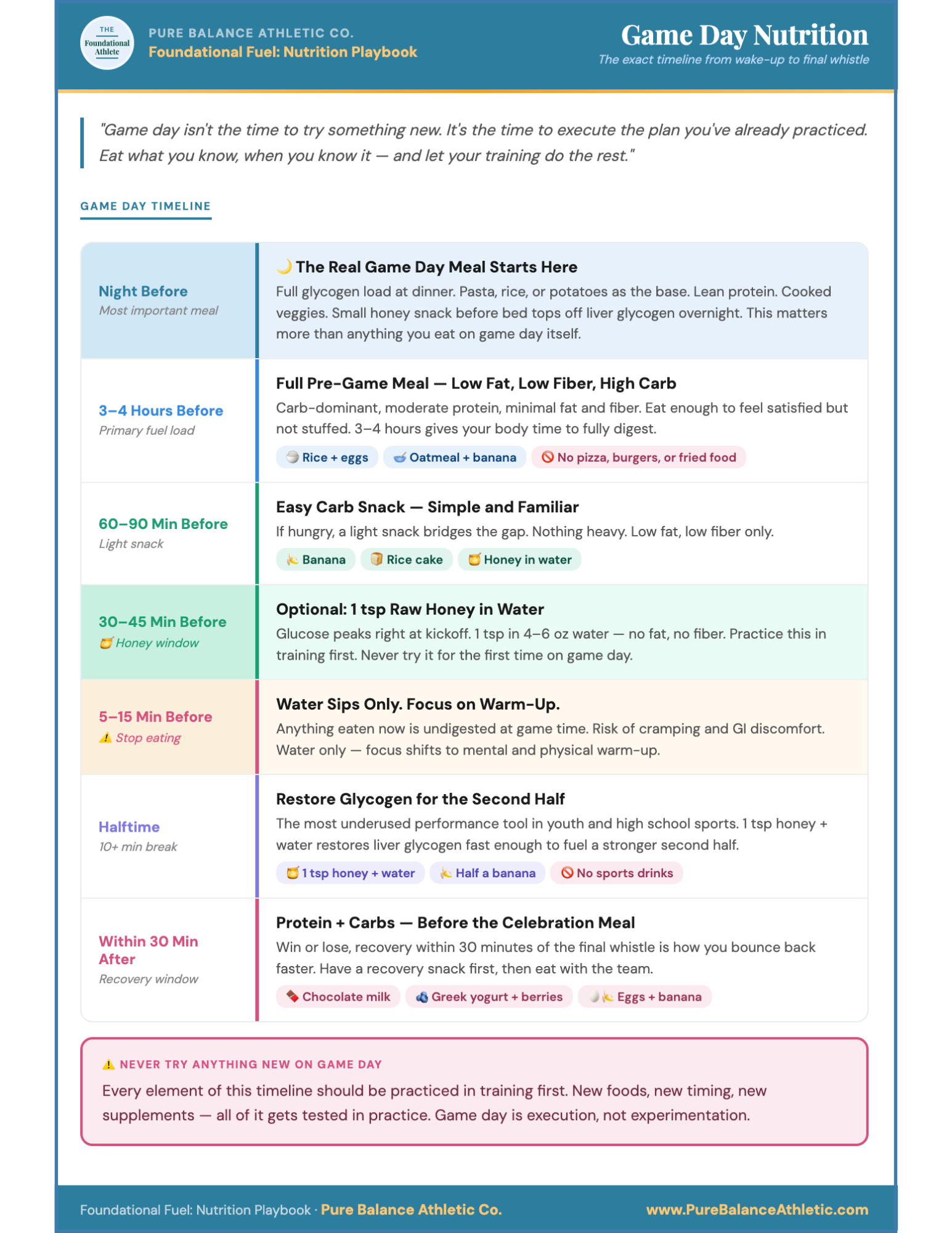
Glycogen stored during sleep is the primary fuel for first-inning explosiveness. A high-carbohydrate dinner with quality protein ensures full muscle glycogen going into game day. This is especially important for pitchers who will throw 75–100+ pitches and need sustained power output, and for players in doubleheaders where the second game is entirely dependent on overnight and between-game fueling.
Carb + protein load
🌅Morning Of
2–3 hrs before
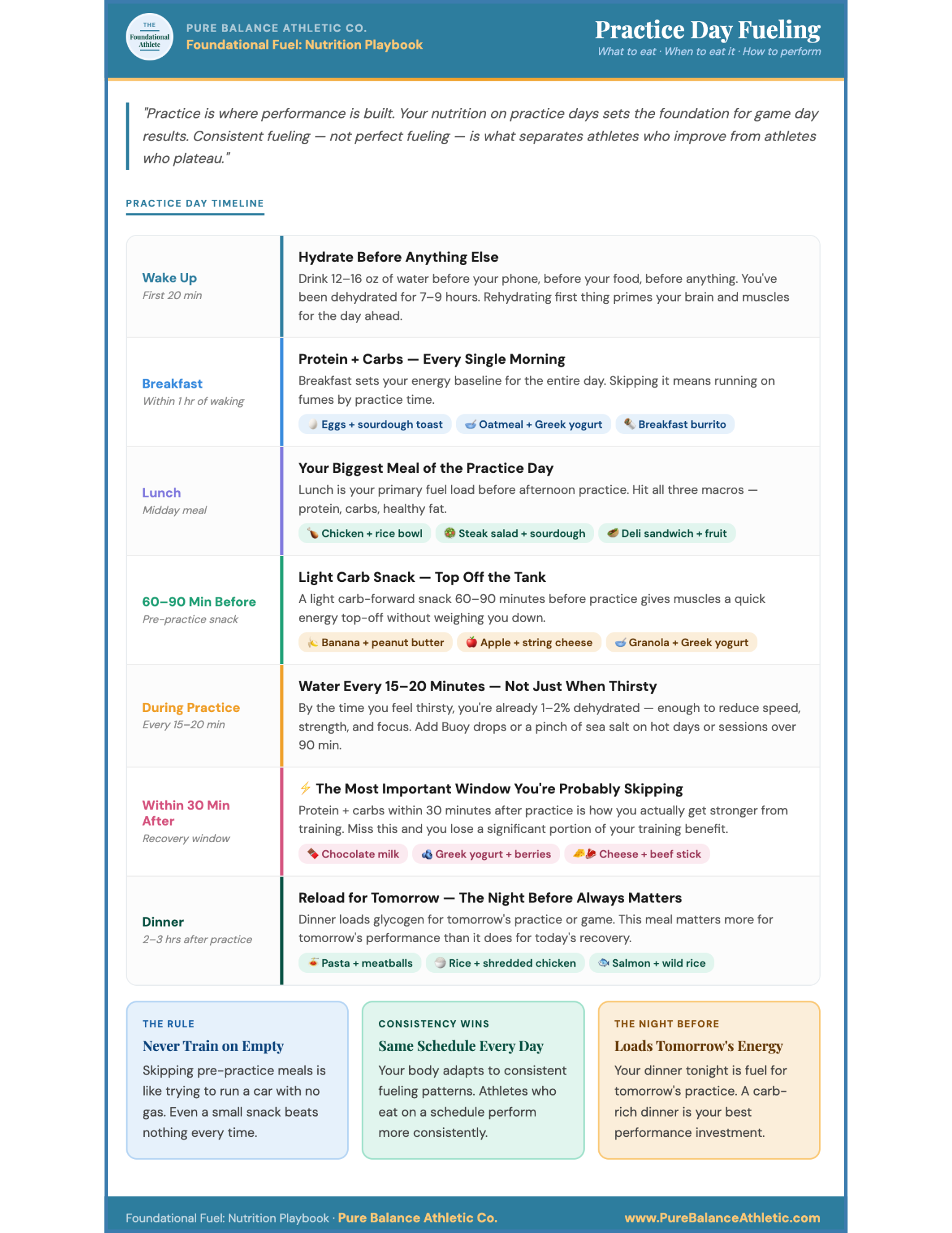
A complete breakfast 2–3 hours before first pitch tops off glycogen and provides protein to protect muscle through a long game. Eating too close to game time causes GI distress during play — fielding ground balls and swinging a bat with a full stomach is uncomfortable and impairs performance. High-sugar breakfasts (cereal, pastry, juice) create an energy crash that typically hits the 4th–5th inning.
Real food + slow carbs
⚾During Game
Every half inning
Consistent hydration every half inning in the dugout — not just when thirsty. Light snacks between innings maintain blood glucose for late-game cognitive sharpness. The dugout is actually an advantage over other sports — athletes have natural breaks to hydrate and snack. Most baseball players dramatically underuse this opportunity by drinking nothing or sipping sports drinks.
Hydrate + light fuel
🏁After Final Out
Within 30 min
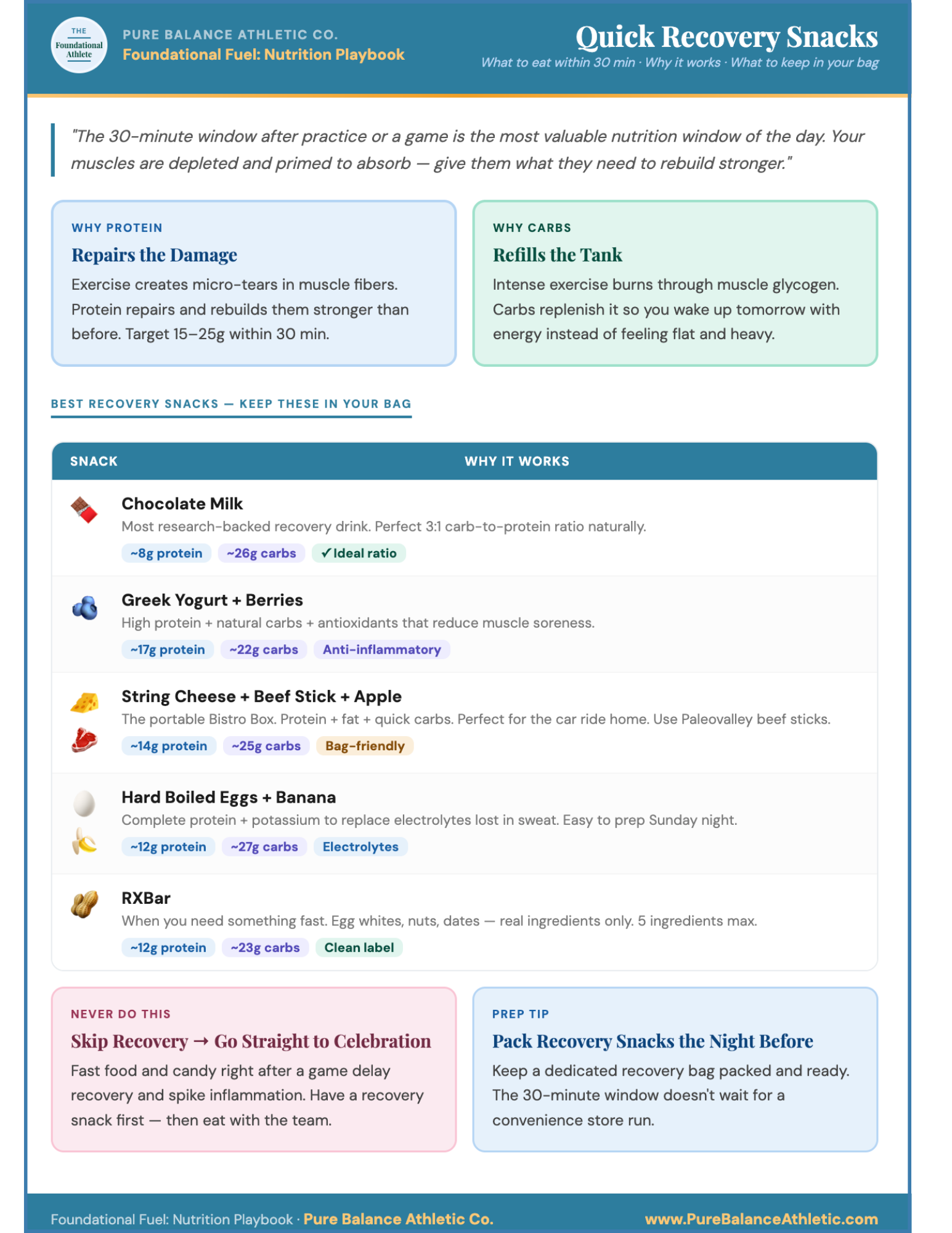
After 2.5–3+ hours of competition in heat, muscle glycogen is depleted and inflammatory markers are elevated from throwing and sprinting demands. The 30-minute post-game window is when GLUT-4 receptors are most active. For athletes in doubleheaders, the between-game nutrition window is the most critical — recovery from game 1 directly determines energy availability for game 2.
Protein + carbs now
Position-by-position nutrition strategy
Pitcher — Highest demands on the field
Why pitchers need the most fuel
A starting pitcher throws 75–100+ pitches, each requiring maximal explosive rotational power. The cumulative caloric expenditure of a full pitching outing rivals most continuous-effort sports.
Night before: Highest carb intake of any position player. Rice + protein is ideal.
Morning of: Full breakfast 2–3 hrs before game. Eggs + sourdough + banana is optimal.
Between innings: Water + electrolytes every half inning. Banana between 3rd and 4th inning if energy dips.
Post-outing: Protein + carbs within 30 min is critical for arm recovery — muscle micro-damage from pitching is significant.
Catcher — Most physically demanding position
Why catchers need the most hydration
Full gear in summer heat creates sweat rates comparable to distance running. Core temperature elevates significantly behind the plate across a full game.
Hydration: Double the standard water intake. 48–64 oz minimum on a warm day. Buoy drops in every bottle.
Between innings: Remove helmet and mask to cool down. Drink water every single half inning without exception.
Potassium: Banana or dates between innings to prevent cramping from the repeated squat-to-throw movement pattern.
Post-game: Recovery is more critical than any other position — protein + carbs within 30 min, then a full recovery meal.
Infield & Outfield — Explosive readiness every pitch
Why fielders must stay fueled through all innings
Every single pitch requires a fielder to be in ready position — mentally engaged, muscles primed for explosive movement. Glycogen depletion in late innings is what causes the slow first step on a ground ball in the 6th inning.
Infielders: Lateral quickness depends on topped-off glycogen. Light carb snack (banana, rice cakes) between innings maintains this.
Outfielders: Sun exposure + long standing periods increases dehydration risk. Drink in the dugout every half inning without fail.
Both: Mental focus for situational awareness must be maintained all game — blood glucose snacks in the dugout support this directly.
DH & Utility — Peak for the at-bat
Timing nutrition around at-bats
Designated hitters and utility players need to be physically and cognitively peak at unpredictable moments across the game. Unlike fielders who are active every inning, DHs must maintain arousal and focus during long periods of inactivity.
Light carbs 30–45 min before likely at-bat: Banana or dates provide quick glucose for the nervous system without making the athlete feel heavy at the plate.
Avoid eating immediately before an at-bat — digestion diverts blood flow away from muscles and brain. Time snacks to be absorbed, not actively digesting.
Doubleheader DH: The between-game window is the most important. Full recovery snack after game 1 before the lineup card for game 2.
⚾ Doubleheader nutrition — winning game 2 starts after game 1
Within 10 min after game 1
Immediate recovery fuel
Hard-boiled eggs + banana, or beef stick + fruit. This starts glycogen restoration and muscle repair before the between-game countdown begins.
20–30 min between games
Recovery + re-fuel meal
Rice cakes + nut butter + banana, or Greek yogurt + granola. Carbs + protein in a portable form. This is a full refueling window — not a snack.
Before game 2 warm-up
Hydration reset
Refill water bottle with Buoy electrolyte drops. Drink 16 oz before stepping on the field for game 2. Game 1 dehydration compounds into game 2 if not addressed.
What to pack and why — every approved food explained
| Food | When | Why it works for baseball | Macros |
|---|---|---|---|
Rice + chicken + veggies Lundberg · Organic Valley | Night before | Rice provides the most efficient glycogen loading — no bloating, rapid muscle storage, fully digested overnight. Chicken provides leucine for overnight muscle preparation. The most evidence-based pre-game dinner for explosive sports. Especially critical for pitchers and catchers. | High carbsProtein |
Eggs + sourdough + banana Organic Valley · Prager Bros | Morning of game | Choline from eggs directly supports the neuromuscular precision required for batting mechanics, pitch recognition, and fielding reactions. Sourdough's fermentation process lowers glycemic index for sustained energy through 7 innings. Banana provides potassium for cramp prevention and fast-acting carbohydrates. | ProteinSlow + fast carbsElectrolytes |
Banana or medjool dates | Dugout between innings | Fast-digesting whole food carbohydrates that maintain blood glucose during the middle innings when mental and physical performance typically decline. Bananas provide potassium — the electrolyte most depleted in athletes throwing and sprinting in summer heat. Dates are higher glycemic for a faster energy response between at-bats. | Fast carbsPotassium |
Beef stick + apple Paleovalley | Dugout / doubleheader | Paleovalley grass-fed beef provides complete protein, zinc, and creatine — supporting the repeated explosive rotational power required by pitchers and hitters. Apple delivers natural fructose for dual-pathway energy. No refrigeration needed in the dugout bag. Zero seed oils, nitrates, or chemical additives. | Complete proteinNatural carbs |
Rice cakes + nut butter Lundberg | Dugout / extra innings | The cleanest slow-release energy combination in the dugout bag. Lundberg rice cakes digest easily without GI distress during active play. Nut butter fat slows glucose absorption — preventing the energy spike-and-crash pattern that Gatorade creates. Ideal for long games, extra innings, and doubleheaders. | Slow carbsHealthy fat |
Hard-boiled eggs + banana Organic Valley | Post-game / between DH games | The most complete post-game recovery combination available. BV-100 protein from eggs initiates immediate muscle repair. Banana restores glycogen and provides potassium for muscle recovery. Between doubleheader games, this combination eaten within 10 minutes of the final out sets up game 2 performance more effectively than any other option. | Complete proteinFast carbs |
Hu dark chocolate + walnuts Hu chocolate chips | Dugout between innings | Hu contains no refined sugar, dairy, or seed oils. Flavonoids in dark chocolate improve cerebral blood flow — directly supporting the pitch recognition, situational awareness, and sign-reading that baseball demands cognitively. Walnuts add omega-3s for anti-inflammatory support during a long game. A small amount between innings improves mental sharpness without GI impact. | Healthy fatFlavonoids |
The sunflower seed problem — every baseball parent needs to know this
Sunflower seeds are a baseball tradition — but they are not a nutrition strategy. The sodium content in salted sunflower seeds without adequate water intake accelerates dehydration rather than preventing it. Most players consume sunflower seeds in the dugout as a habit while drinking little water — a combination that produces mild but meaningful dehydration by the middle innings. If your athlete uses sunflower seeds, pair them with at least 8 oz of water per handful and ensure Buoy electrolyte drops are in their water bottle throughout the game. The seeds themselves are not harmful — the habit of eating them without adequate hydration is the problem.
Hydration strategy for game day
✅ Approved hydration for a baseball game
💧
Water (32–64 oz depending on heat) — Sip every half inning in the dugout. Catchers: minimum 48 oz on warm days due to gear. Start pre-hydrating the morning of the game with 16 oz before breakfast.
🫧
Buoy electrolyte drops — Add to the main water bottle from warm-up through the final out. Replaces sodium, potassium, and magnesium lost in sweat. Zero sugar, zero dye. The only electrolyte source approved in this program.
🍋
Lemon + sea salt water — Natural electrolyte backup for the second bottle. Provides sodium and vitamin C. Especially helpful for catchers and pitchers who sweat most heavily.
🍌
Potassium-rich foods throughout — Bananas and dates in the dugout specifically address electrolyte depletion from sweat and the cramping risk in throwing athletes and catchers.
🚫 What to avoid on game day
⚡
Sports drinks (Gatorade, Powerade) — 34g added sugar creates a glucose spike that peaks during warm-up and crashes in the 4th–5th inning. The dyes and artificial flavors are unnecessary additives for a healthy 13–18 year old athlete.
⚡
Energy drinks — Never on game day. Caffeine elevates anxiety and heart rate — counterproductive to the calm, focused state that batting and pitching require. Contraindicated for all players ages 13–18.
🍔
Fast food between doubleheader games — One of the most common and costly mistakes in travel baseball. High fat content slows gastric emptying, causing GI distress in game 2. Stick to the prepared bag food between games — every time.
🌻
Sunflower seeds without water — See above. The tradition is fine; the habit of eating them without adequate hydration is not. Sodium without water = accelerated dehydration.
The science behind baseball game day nutrition
Glycogen & explosive power in baseball
Pitching, hitting, and explosive fielding movements all rely on phosphocreatine and muscle glycogen as primary fuel — the same systems used in sprinting. Fat oxidation contributes virtually nothing to these efforts. Research confirms that glycogen depletion reduces peak power output measurably — meaning a pitcher's velocity drops in later innings not just from fatigue but from substrate depletion. Full glycogen stores from the night before and breakfast are the direct intervention for this.
Burke LM et al., JOSPT 2011; Glaister M, Sports Med 2005
Reaction time, pitch recognition & blood glucose
Hitting a baseball is one of the most cognitively demanding tasks in sports — a 90mph fastball reaches the plate in approximately 400ms, leaving roughly 200ms to decide whether to swing. Research shows that blood glucose below optimal range measurably slows reaction time and decision accuracy. The late-inning batting slump that travel coaches see most commonly is partially explained by blood glucose depletion from inadequate between-inning fueling.
Lieberman HR et al., Nutrition Reviews 2007; McMorris T et al., Physiology & Behavior 2006
Heat, dehydration & performance decline in baseball
Studies on dehydration in intermittent-sprint sports show that 1–2% body weight fluid loss reduces sprint speed, throwing velocity, and cognitive function measurably. For a 160lb baseball player that is just 1.6–3.2 lbs of water — easily reached by the 5th inning of a summer afternoon game without intentional hydration. Research on baseball-specific dehydration confirms errors and reaction time decline proportionally with fluid loss.
Maughan RJ & Shirreffs SM, Sports Med 2010; Baker LB et al., JSCR 2007
Arm health, protein & throwing recovery
Pitching produces significant muscle micro-damage in the rotator cuff, forearm flexors, and posterior chain. Protein consumed within 30 minutes post-outing initiates muscle protein synthesis and reduces inflammatory markers — directly supporting arm health across a long season. Zinc (from grass-fed beef and eggs) and omega-3s (from salmon) further support the repair of throwing-related tissue stress. For year-round travel pitchers, post-outing nutrition is a genuine arm care strategy.
Tipton KD, Sports Med 2015; Smith-Ryan AE et al., JSCR 2020
Sample game day nutrition schedule
| Time | Action | What to eat / drink | Parent notes |
|---|---|---|---|
| Night before (dinner) | Glycogen load | Rice + chicken + veggies, or pasta + ground beef + marinara. 16 oz water with dinner. | Most important meal. Pitchers especially — don't eat light here. |
| Morning of (2–3 hrs before 1st pitch) | Full breakfast | Eggs + sourdough + banana, or oatmeal + eggs + berries, or egg wrap. 16 oz water. | Non-negotiable. Skipping breakfast = running on empty by the 4th inning. |
| Arrival at field / warm-up | Fill water + electrolytes | 32 oz water with Buoy drops. Begin sipping during warm-up — not first pitch. | Pre-hydration during warm-up dramatically reduces mid-game dehydration. |
| Every half inning (dugout) | Hydrate | Sip water consistently. Banana or dates between innings if energy dips. | The dugout is an advantage — use it. Most players drink nothing between innings. |
| 3rd–4th inning (mid-game) | Light refuel | Banana, rice cakes + nut butter, or cheese + grapes if there's a long gap. | Prevents the 5th–7th inning energy and focus drop. |
| Within 30 min after final out | Recovery | Hard-boiled eggs + banana, beef stick + fruit, or Greek yogurt + granola. | Have this ready at the car or in the dugout bag. Don't wait for the team meal. |
| Doubleheader — between games | Rapid refuel | Eggs + banana + rice cakes, or Greek yogurt + granola + water. 16 oz water with Buoy drops. | This is a full refueling window, not a snack. Game 2 depends on it. |
Parent prep tips for game day
Pack the dugout bag the night before
Game days — especially tournament weekends — are chaotic. Having the entire dugout bag packed, water bottles filled, and cold packs in place the evening before removes every food decision from the morning rush.
Cold pack is essential
Hard-boiled eggs, Greek yogurt, and cheese need refrigeration. A proper insulated bag with cold packs keeps everything food-safe through a 3-hour game in summer heat. This is non-negotiable for tournament weekends.
Tournament weekends require a full plan
A two-day travel tournament with 4–6 games requires a complete nutrition plan before you leave home. Pack enough approved food for every game, every between-game window, and every post-game recovery. Relying on concession stands at a travel tournament is a guaranteed performance problem.
Catchers need their own hydration plan
If your athlete catches, plan specifically for their elevated hydration needs. Extra water bottle, extra Buoy drops, and bananas specifically for between-inning cramp prevention. The gear creates a heat load that other positions simply don't face.
Remind your athlete to eat in the dugout
Even with the right food in the bag, many teen athletes forget or feel awkward eating in the dugout. A quick reminder before the game — "drink every half inning, banana at the 4th" — is all it takes to turn good intentions into actual fueling.
Plan the team meal in advance
Post-game team meals at fast food or pizza restaurants are a baseball tradition — and they are fine as a social experience. But the recovery food window is 30 minutes post-game, not 2 hours later at dinner. Have the recovery snack ready at the field so the window is covered regardless of where the team eats afterward.
Common parent questions
My pitcher says he can't eat before he pitches because of nerves. What do we do?
Pre-game nausea is extremely common in pitchers — the adrenaline response suppresses appetite and increases GI sensitivity. The solution is timing and food choice rather than skipping. Move the meal to 3 hours before first pitch, reduce portion size, and choose lower-fiber options (sourdough toast with eggs rather than a full oatmeal bowl). Banana + RXBar is a solid option when nerves make a full meal impossible. Fasting into a pitching start with 75–100 throws is one of the most common and preventable performance mistakes in youth baseball.
What about the team snack — usually chips and Gatorade after the game?
Team snacks are a social tradition and there's real value in the post-game team ritual. The practical solution: have your athlete eat their recovery snack (eggs + banana, beef stick + fruit) within 30 minutes of the final out, before the team snack is distributed. By the time the team snack comes around, the critical recovery window is already covered and the chips and Gatorade are just a social moment rather than a nutrition decision. This approach respects the team tradition without sacrificing your athlete's recovery.
My player's velocity drops every game in the 5th and 6th innings. Is that nutrition?
Partly, yes — and it's one of the most addressable performance problems in youth pitching. Late-inning velocity drop has multiple causes (fatigue, mechanics breakdown, pitch count), but blood glucose depletion and dehydration contribute meaningfully and are entirely fixable. Ensure the pitcher had a complete breakfast 2–3 hours before first pitch, is drinking water every half inning in the dugout, and has a banana or dates available between the 3rd and 4th inning. These changes alone often produce measurable late-game velocity improvement within 2–3 starts.
How do we handle nutrition during a long tournament weekend with 4–5 games?
Tournament nutrition requires preparation before you leave home. Pack a full cooler with approved foods for every game: hard-boiled eggs, beef sticks, bananas, rice cakes, nut butter, Lundberg rice cakes, Buoy drops, and Greek yogurt. Plan the between-game recovery meals specifically — this is when most tournament athletes fail. The athletes who improve across a weekend tournament are the ones fueling recovery between games; the ones who decline are the ones relying on concession stands and fast food. The investment of 30 minutes packing a proper cooler before a tournament is the highest-return performance intervention available.
"The at-bat in the 6th inning is won at dinner the night before and breakfast that morning. Nutrition doesn't show up in the stat line — it shows up in the moments that determine the stat line."
Key references
Burke LM et al. (2011). Carbohydrates for training and competition. JOSPT. · Lieberman HR et al. (2007). Hydration and cognitive function. Nutrition Reviews. · Maughan RJ & Shirreffs SM (2010). Dehydration and rehydration in competitive sport. Sports Medicine. · Tipton KD (2015). Nutritional support for exercise-induced injuries. Sports Medicine. · Smith-Ryan AE et al. (2020). Nutritional considerations for the injured athlete. JSCR. · McMorris T et al. (2006). Acute, intermediate intensity exercise and speed and accuracy of cognitive performance. Physiology & Behavior.

Nutrition Quick Guides
Explore these additional resources for more insights.