⚽

Parent Guide · Soccer · Ages 13–18 · Boys & Girls · Club & High School
Game Day Nutrition — The Why Behind Every Choice
The Foundational Athlete · Pure Balance Athletic Co.
Why soccer game day nutrition is uniquely demanding
Soccer is the most aerobically demanding team sport — elite youth players cover 6–8 miles per 90-minute game with repeated explosive sprints, direction changes, and high-intensity pressing sequences. Glycogen is the primary fuel and it depletes progressively across both halves. Research consistently shows that second-half performance decline in youth soccer is not a fitness problem — it is a nutrition and hydration problem. The night-before dinner, morning breakfast, halftime refuel, and post-game recovery window each play a direct, measurable role in whether your athlete dominates the second half or fades when it matters most.
What makes soccer nutritionally unique
Highest aerobic demand in team sports
A competitive youth soccer player runs 6–8 miles per game with no substitution (for 90 minutes of play). Midfielders often exceed 8 miles. The continuous nature of the game — unlike baseball or football — means glycogen is being depleted from the first whistle to the last. There are no natural rest periods to recover. Full fuel stores before kickoff are not optional — they are the performance foundation.
Halftime — the critical 15-minute window
Soccer is unique in providing a defined 15-minute halftime window between 45-minute halves. This is the single most important nutrition intervention available during a game. Research shows that consuming fast-digesting carbohydrates at halftime measurably improves second-half sprint speed, total distance covered, and high-intensity effort frequency. Most youth teams squander this window with water only.
Heat, turf, and continuous dehydration
Youth club and high school soccer is frequently played on artificial turf in afternoon heat. Turf surface temperatures can exceed air temperature by 30–50°F, dramatically increasing sweat rates. Combined with the high running volume, dehydration accumulates rapidly. Research confirms that even 1–2% body weight fluid loss reduces sprint speed and decision-making accuracy — both critical in the final 20 minutes of a close game.
The four nutrition windows of a soccer game
🌙Night Before
Dinner
The night-before dinner is the most important meal of game day. Glycogen stored in muscles during sleep provides the fuel for the first 60–70 minutes of a 90-minute game. A high-carbohydrate dinner with quality protein ensures full muscle glycogen stores. This is especially important for midfielders who cover the most ground and for tournament days where multiple games are played.
Biggest carb meal of the week
🌅Morning Of
2–3 hrs before
Tops off glycogen and provides protein to protect muscle through 90 minutes. Eating too close to kickoff causes GI distress during high-intensity running. High-sugar breakfasts (cereal, pastry, juice) create an energy crash that typically hits around the 30–35 minute mark. Eat 2–3 hours before kickoff — not before warm-up.
Real food + slow carbs
⏱️Halftime
15-min window
The single most impactful in-game nutrition intervention in soccer. After 45 minutes of high-intensity running, muscle glycogen is measurably reduced and electrolytes are depleted. Fast-digesting carbohydrates consumed at halftime are absorbed during the break and available as fuel in the 46th minute. This is the window that determines second-half sprint speed and finishing quality.
Fast carbs + electrolytes
🏁Post-Game
Within 30 min
After 90 minutes of running, muscle glycogen is significantly depleted and inflammatory markers are elevated from the physical demands of the game. Protein + carbohydrates within 30 minutes initiate muscle repair and glycogen restoration. This window is especially critical on tournament weekends where games are played on consecutive days — recovery from game 1 directly impacts performance in game 2.
Protein + carbs now
⏱️ The halftime protocol — win the second half in 15 minutes
First 5 minutes
Water + electrolytes immediately
Drink 8–12 oz with Buoy drops as soon as you reach the locker room or touchline. Replace what was lost in the first half before eating anything.
Minutes 5–10
Fast carbs — banana, orange, or dates
Fast-digesting carbohydrates need 10–15 minutes to reach the bloodstream. Eating them in the middle of halftime ensures they are available as fuel by the 55th–60th minute when sprint speed matters most.
Final 5 minutes
Second sip of water before kickoff
Final hydration top-off before the second half begins. Goalkeepers and midfielders especially — the second half starts with full hydration, not chasing a deficit from the first half.
Position-by-position nutrition strategy
Goalkeeper — Explosive readiness every moment
Energy demands
Goalkeepers cover less distance (3–4 miles) but require maximal explosive power for every save, distribution, and aerial challenge. The phosphocreatine system is the primary fuel — meaning full glycogen stores are still critical for peak diving and jumping power.
Key nutrition focus
Dehydration risk is often underestimated — GKs sweat significantly despite lower mileage. Drink every time play stops.
Pre-game breakfast is essential. Even though GKs run less, explosive save mechanics require full glycogen in the leg and core muscles.
Halftime: Banana + water + electrolytes. Use the halftime window fully — don't skip because you "didn't run as much."
Midfielder — Highest mileage, highest fuel needs
Energy demands
Central midfielders cover 7–9 miles per game — the most of any position. Box-to-box running, defensive pressing, and attacking runs mean continuous glycogen depletion for 90 minutes. Midfielders are the most nutritionally demanding position on the pitch.
Key nutrition focus
Night-before dinner is non-negotiable at a higher carb intake than any other position. Full glycogen going in.
Halftime banana + dates are especially critical for midfielders. Second-half pressing capacity depends on how well glycogen was restored at the break.
Hydration every stoppage — corners, free kicks, throw-ins when not involved. Midfielders dehydrate faster than any other position.
Defender — Sprint speed when it counts most
Energy demands
Defenders cover 5–6 miles per game with repeated explosive defensive sprints. The critical demands come in concentrated bursts — a momentary lapse in sprint speed in the 75th minute causes goals. Late-game defensive errors are often glycogen-related, not concentration-related.
Key nutrition focus
Full breakfast 2–3 hours before kickoff is essential for the explosive sprint capacity that defensive coverage requires.
Halftime fast carbs restore the glycogen needed for second-half defensive sprints. A banana at halftime can be the difference between winning and conceding an 80th-minute counter-attack.
Potassium from bananas helps prevent the hamstring cramping that commonly affects defenders tracking runners late in games.
Forward — Explosive finishing quality
Energy demands
Forwards run 5–7 miles with the highest proportion of high-intensity explosive sprints. Finishing quality depends on maximal explosive power and precise neuromuscular coordination at the moment of the chance — often in the 70th–90th minute when glycogen is most depleted.
Key nutrition focus
Second-half finishing depends entirely on halftime carb restoration. Forwards who eat a banana at halftime score more in the second half — this is not an exaggeration.
Choline from eggs at breakfast directly supports the neuromuscular precision of shooting mechanics and first-touch control under defensive pressure.
Post-game protein is critical for forwards who sprint heavily. Muscle protein synthesis after high-intensity running requires leucine-rich protein within 30 minutes.
👧 Girls soccer — additional nutritional considerations
Female athletes in soccer have specific nutritional considerations beyond what the general guide covers. Iron deficiency is significantly more common in female athletes — particularly during growth phases — and impacts oxygen delivery to working muscles, directly reducing endurance capacity. Eggs and red meat (approved in this program) are among the best dietary iron sources. Relative Energy Deficiency in Sport (RED-S) is a real risk in competitive female soccer — underfueling relative to training and game demands impairs performance, bone density, hormonal function, and immune health. If your daughter is training and competing at a high level but chronically fatigued, experiencing frequent illness, or not improving despite consistent training — nutrition adequacy should be the first thing evaluated, not fitness. Caloric restriction in any form is contraindicated for competitive female athletes ages 13–18. Fuel the performance. Build the foundation.
What to pack and why — every approved food explained
| Food | When | Why it works for soccer | Macros |
|---|---|---|---|
Pasta + ground beef + marinara Kirkland organic marinara | Night before | Pasta is the most widely researched and validated pre-game carbohydrate loading food in soccer specifically. Muscle glycogen storage from a pasta dinner has been shown to improve second-half distance covered and sprint frequency compared to lower-carbohydrate dinners. Ground beef provides complete protein and creatine for next-day explosive performance. | High carbsProtein |
Eggs + sourdough + banana Organic Valley · Prager Bros | Morning of game | Choline from eggs supports the rapid neuromuscular decision-making required for dribbling, pressing, and off-ball movement reading. Sourdough's lower glycemic index prevents the energy crash that typically hits around the 30th minute in athletes who eat high-sugar breakfasts. Banana provides potassium for cramp prevention across 90+ minutes of running. | ProteinSlow + fast carbsElectrolytes |
Banana at halftime | Halftime | The banana is the most important halftime food in soccer — not by tradition but by science. It provides glucose and fructose for dual-pathway energy delivery, potassium to reduce second-half cramping risk, and vitamin B6 for serotonin production that supports mood and focus under second-half pressure. Research shows halftime carbohydrate consumption improves second-half sprint speed by 4–7%. | Fast carbsPotassium |
Orange slices | Halftime | The traditional halftime orange exists for nutritional reasons: fast-digesting natural glucose + fructose for dual energy pathway delivery, vitamin C for tissue protection and immune support, and high water content for hydration alongside the carbohydrate load. The combination of hydration and carbohydrates in one food makes it uniquely effective for the 15-minute halftime window. | Fast carbsVitamin C |
Medjool dates (2–3) | Halftime | Dates have one of the highest glycemic indices of any whole food — delivering glucose rapidly to depleted muscles. Two or three dates at halftime provides approximately 30–40g of fast-absorbing carbohydrates — equivalent to a sports gel but with natural fiber, potassium, and no additives. The preferred halftime option for midfielders who have the highest glycogen depletion. | High fast carbsPotassium |
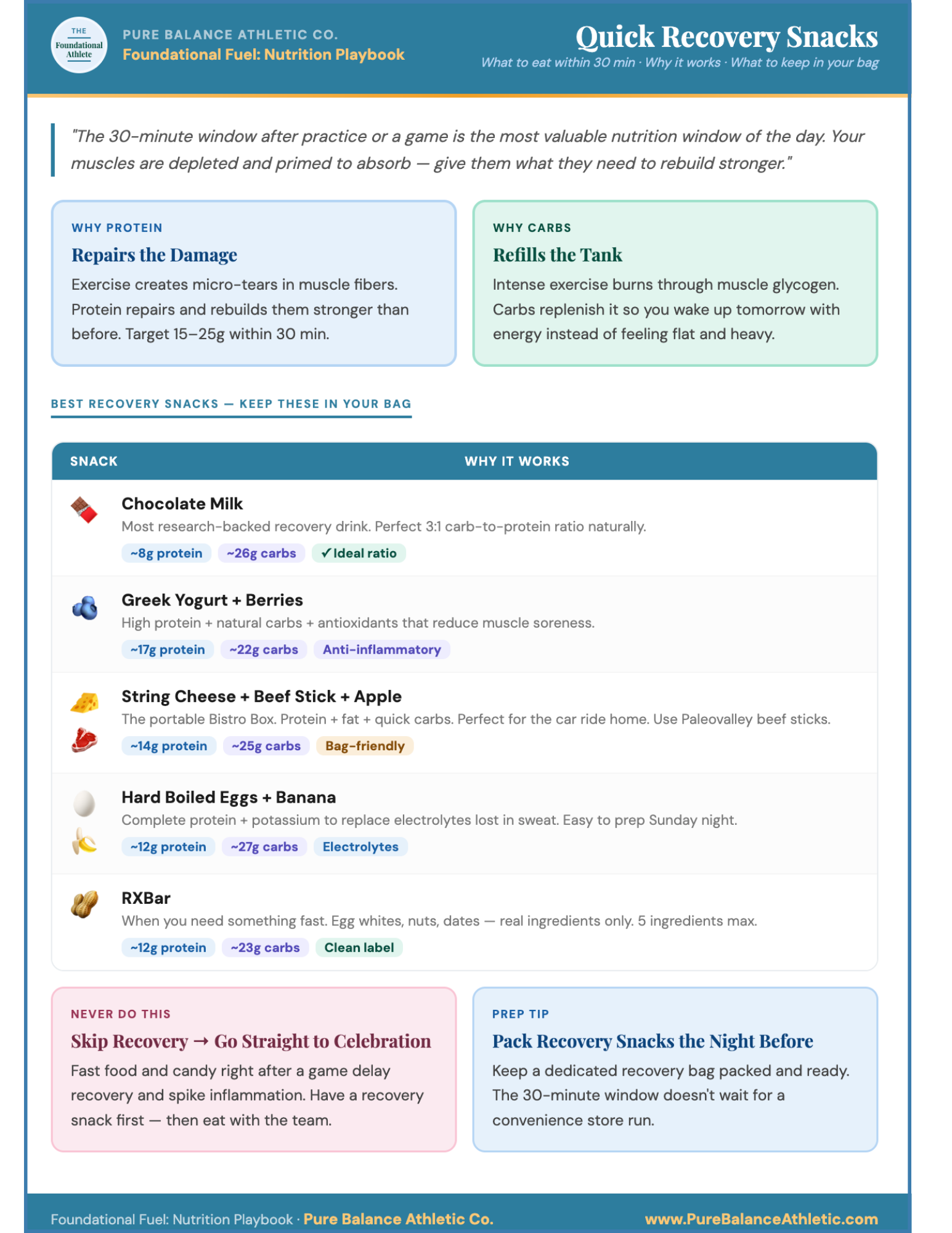
Hard-boiled eggs + banana Organic Valley | Post-game | The most complete post-game recovery combination. BV-100 protein from eggs initiates immediate muscle protein synthesis for the micro-damage sustained from 90 minutes of high-intensity running. Banana restores glycogen rapidly. On tournament weekends, this combination within 30 minutes of the final whistle directly determines whether recovery is complete before the next game. | Complete proteinFast carbs |
Paleovalley beef stick + apple Paleovalley | Post-game | Grass-fed beef provides complete protein, creatine, and zinc — all critical for the muscle repair needed after high-mileage game performance. Apple delivers natural fructose + glucose for dual-pathway glycogen restoration. No refrigeration needed — eat at the pitch before the car ride home. Zero seed oils, nitrates, or chemical additives. | Complete proteinNatural carbs |
Hydration strategy for 90 minutes
✅ Approved hydration for a soccer game
💧
Water (40–60 oz for a 90-min game) — Drink at every stoppage — corners, free kicks, injuries. Midfielders need 60+ oz on warm days. Start pre-hydrating 16 oz at breakfast and 8 oz during warm-up.
🫧
Buoy electrolyte drops — Add to the water bottle before kickoff and refill with drops at halftime. Sodium, potassium, and magnesium lost in 90 minutes of running must be replaced. Zero sugar, zero dye. Non-negotiable on turf and in heat.
🍋
Lemon + sea salt water — Natural electrolyte backup for a second bottle used at halftime. Provides sodium and vitamin C in a clean, additive-free format.
🍌
Potassium throughout — Bananas and dates provide potassium that specifically reduces hamstring and calf cramping risk — the most common late-game cramping sites in soccer. Both are approved halftime foods.
🚫 What to avoid on game day
⚡
Sports drinks (Gatorade, Powerade) — 34g added sugar per bottle creates a glucose spike followed by a crash that typically hits the 50th–55th minute. Research on soccer-specific performance confirms artificial sports drinks do not outperform water + real food carbohydrates for youth athletes.
⚡
Energy drinks — Never on game day for ages 13–18. Caffeine and stimulants impair the fluid balance, increase heart rate beyond normal game demands, and elevate anxiety — all counterproductive to consistent 90-minute performance.
🍔
Fast food or heavy meals before games — High fat content slows gastric emptying significantly. A meal with significant fat or fiber within 2 hours of kickoff causes GI distress during high-intensity running. Stick to the approved breakfast options.
🚫
Skipping halftime nutrition — Drinking water only at halftime is the single most common and impactful nutrition mistake in youth soccer. The 15-minute window is the one guaranteed chance to meaningfully improve second-half performance. Use it.
The science behind soccer game day nutrition
Glycogen depletion & second-half performance
Research on professional and elite youth soccer consistently shows that muscle glycogen is significantly reduced by halftime in players who did not carbohydrate load the night before. The second-half performance decline seen in most youth games — lower sprint frequency, reduced pressing intensity, more defensive errors — is largely explained by glycogen depletion. The night-before dinner and halftime carbohydrates are the two most impactful interventions available.
Bangsbo J et al., Sports Med 2006; Stolen T et al., Sports Med 2005
Halftime carbohydrates & second-half sprinting
A landmark study by Ali et al. (2007) showed that consuming carbohydrates at halftime improved second-half sprint speed by 4–7% and total high-intensity distance by 23% compared to water only at halftime. The mechanism is simple: fast carbohydrates eaten during the break are partially absorbed by the 50th–55th minute, providing supplemental glucose when muscle glycogen is depleted. This is one of the most impactful and underutilized interventions in youth soccer.
Ali A et al., IJSNEM 2007; Nicholas CW et al., Int J Sport Nutr 1995
Dehydration on turf & decision-making
Studies on artificial turf show surface temperatures can exceed 160°F in direct sun, increasing sweat rate dramatically compared to natural grass. 1–2% body weight fluid loss reduces sprint speed, agility, and decision-making accuracy in soccer-specific tests. For a 130lb player, that is just 1.3–2.6 lbs of fluid — easily reached by the 60th minute of a summer afternoon game without intentional hydration. Poor passing decisions in the final 20 minutes are frequently dehydration events, not technical failures.
McGregor SJ et al., JOSPT 1999; Mohr M et al., Scand J Med Sci Sports 2010
Cognitive performance & pitch intelligence
Soccer requires continuous real-time decision-making — reading space, tracking runners, anticipating ball movement under physical fatigue. Research shows blood glucose below optimal range measurably slows processing speed and decision accuracy in intermittent sport athletes. The tactical errors youth coaches see most often in the final 15 minutes — wrong decisions under pressure, missed defensive assignments, poor shot selection — are frequently blood glucose events as much as cognitive ones. Halftime carbohydrates directly address this.
Lieberman HR, Nutrition Reviews 2007; Welsh RS et al., J Appl Physiol 2002
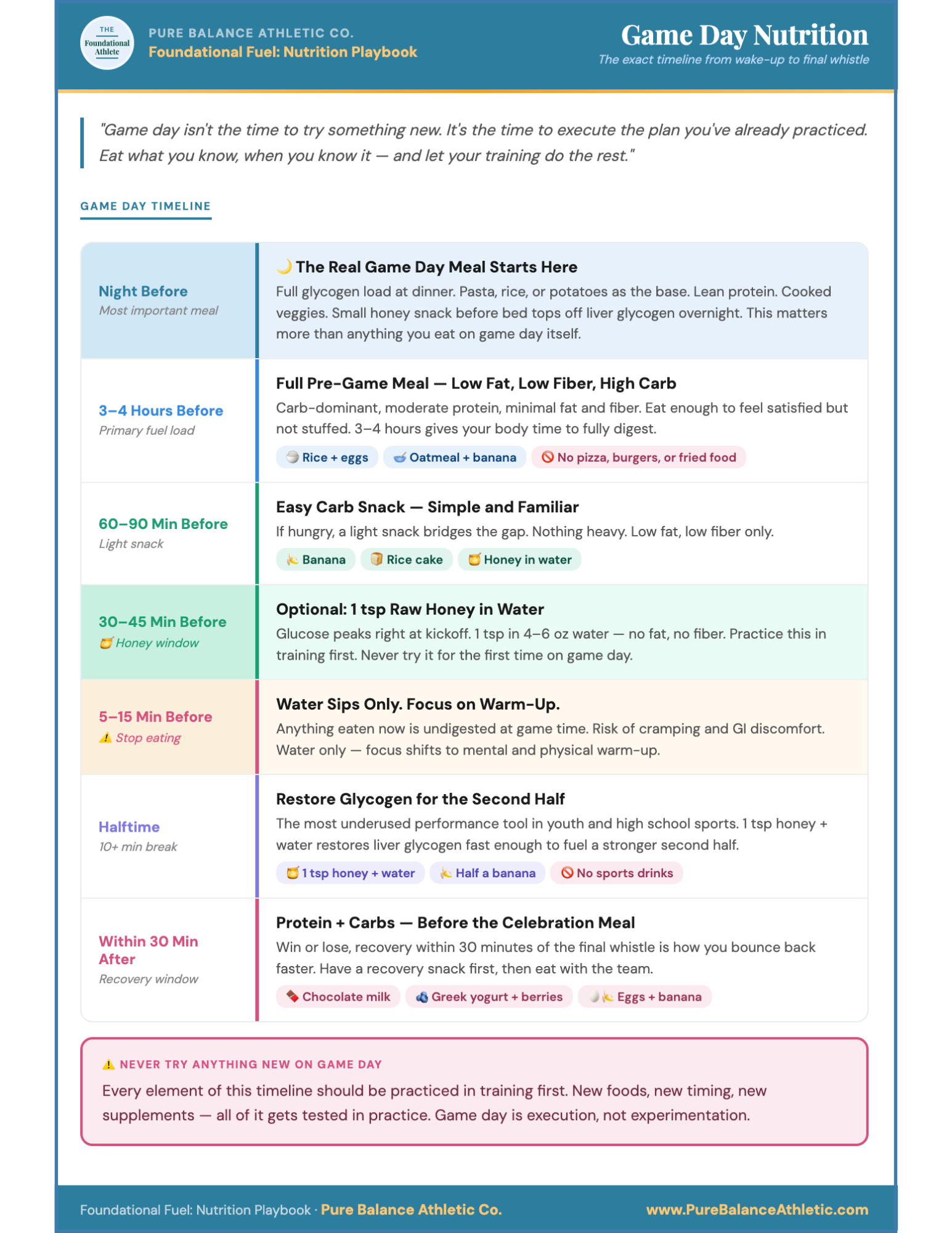
Sample game day nutrition schedule
| Time | Action | What to eat / drink | Parent notes |
|---|---|---|---|
| Night before (dinner) | Glycogen load | Pasta + ground beef + marinara, or rice + chicken + veggies. 16 oz water with dinner. | Biggest carb meal of the week. Don't eat light here — midfielders especially. |
| Morning of (2–3 hrs before kickoff) | Full breakfast | Eggs + sourdough + banana, or oatmeal + eggs + berries, or egg wrap. 16 oz water. | Non-negotiable. Skipping breakfast = running out of fuel in the second half. |
| 60 min before kickoff | Optional top-off | Banana or rice cakes + nut butter if breakfast was early (3+ hrs ago). 8 oz water. | Only if there's a long gap since breakfast. Keep it light. |
| Warm-up | Pre-hydrate | 8–12 oz water with Buoy drops. Begin sipping before the first whistle. | Starts hydration before glycogen depletion begins. |
| Every stoppage during game | Drink water | Sip at every corner, free kick, injury stoppage, or substitution pause. | Midfielders: drink every stoppage without exception. Don't wait for breaks. |
| Halftime (first 5 min) | Water + electrolytes | 8–12 oz water with Buoy drops immediately. Sit down, cool off, breathe. | Hydration before food. Don't eat before rehydrating first. |
| Halftime (min 5–10) | Fast carbs | Banana + orange slices, or 2–3 medjool dates. Small amount only — easy to digest. | This is the most important intervention of the entire game day. Don't skip it. |
| Halftime (final 5 min) | Final water sip | 4–6 oz water before heading back out. No more food. | Second half starts fully hydrated. Set them up for the 80th minute. |
| Within 30 min post-game | Recovery | Hard-boiled eggs + banana, beef stick + fruit, or Greek yogurt + granola. | Have this ready at the car or pitch. Recovery window is 30 min — not dinner. |
Parent prep tips for game day
Pack the kit bag the night before
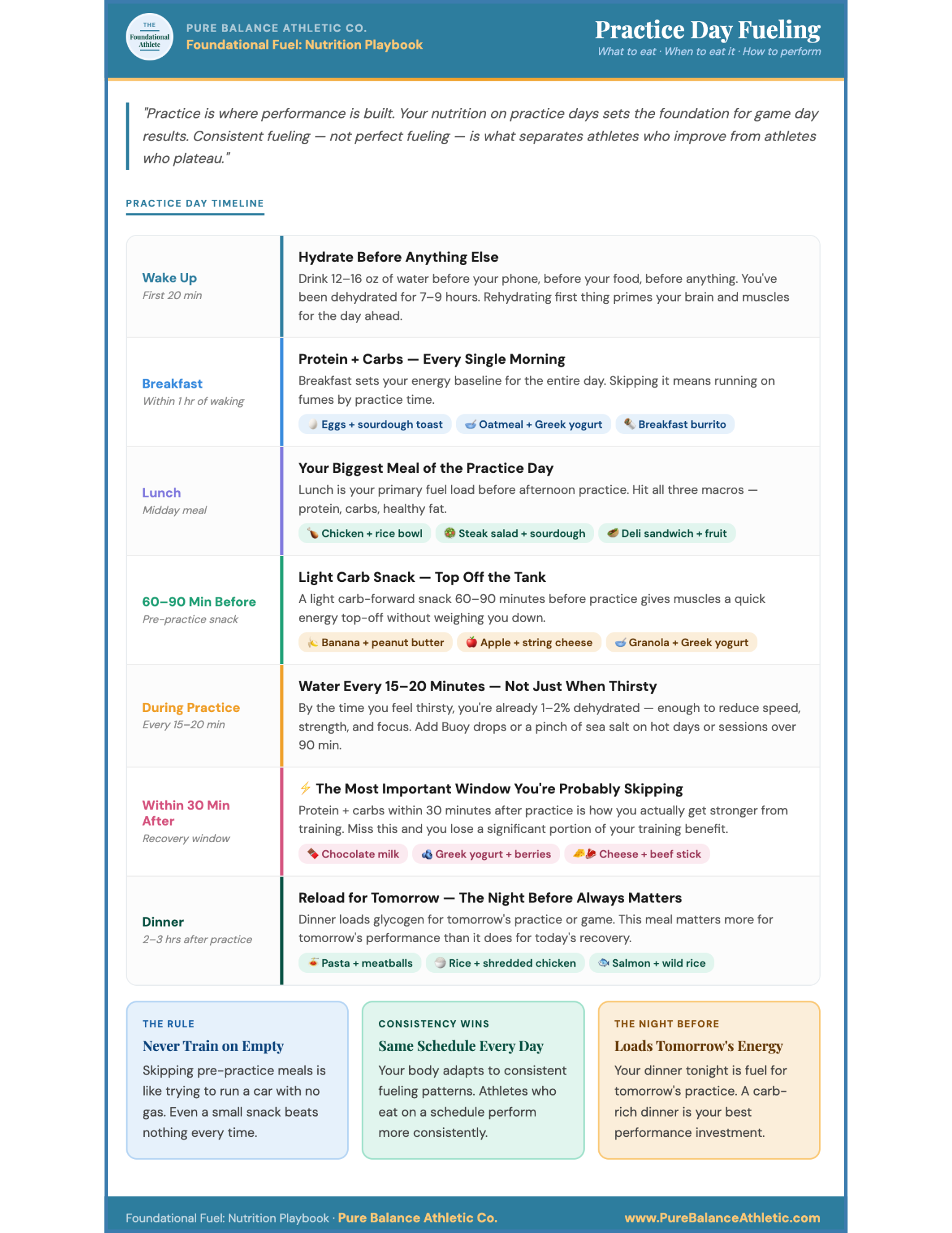
Water bottles, Buoy drops, bananas, halftime fruit, and recovery food — all packed the evening before. Morning game days are chaotic enough without a food prep scramble.
Always pack extra bananas
Two to three bananas per player per game day. One 60 min before kickoff if needed, one at halftime, one post-game. They need no refrigeration and survive a full day in a kit bag. The single most important game day food in soccer.
Cold pack for recovery food
Hard-boiled eggs, Greek yogurt, and cheese need refrigeration. A small insulated bag with a cold pack keeps recovery food safe through a warm afternoon game or tournament day.
Tournament weekends need a full plan
Multiple games in a tournament require deliberate recovery between matches. The 60–90 minute window between games should include protein + carbs immediately after game 1 and a full meal 2 hours before game 2. Bring a proper cooler — don't rely on tournament concession stands.
Brief your player on the halftime plan
Before the game, remind your player: "drink water first at halftime, then banana by minute 8." The halftime window is rushed and emotional — having a pre-agreed plan removes the decision and ensures the nutrition window is used every game.
Adjust for turf and heat
On artificial turf in warm weather, increase water intake by 20–30% and make Buoy drops non-negotiable rather than optional. Turf games are significantly more dehydrating than grass games at the same temperature. Plan accordingly before leaving home.
Common parent questions
My player can't eat before morning games due to nerves. What do we do?
Pre-game nausea is common in competitive soccer players and is driven by the same adrenaline response that powers game performance. The solution is timing and food selection rather than skipping. Move the meal to 2.5–3 hours before kickoff, reduce portion size, and choose lower-fiber, lower-fat options: sourdough toast + banana + 1–2 eggs rather than a full oatmeal bowl. Liquid options work well when solids don't — a smoothie with banana, Greek yogurt, and a little granola provides carbs + protein in a form most nervous athletes can tolerate. Something is always better than nothing.
The team only gets water at halftime. How do I make sure my player gets halftime carbs?
This is an extremely common situation. The solution is to pack the halftime food in your player's own kit bag so it's accessible regardless of what the team provides. A banana or 2–3 dates in the side pocket of a kit bag takes 10 seconds to eat at halftime and doesn't require team coordination. Brief your player before the game: "banana from your bag at halftime, minute 5–10." If the coach is open to it, a conversation with the coaching staff about halftime nutrition for the whole team could benefit every player.
My daughter seems exhausted after games even when she plays well. Is that normal?
Some post-game fatigue is normal — 90 minutes of high-intensity running is genuinely demanding. However, if fatigue is excessive, prolonged (lasting the entire day after a game), or your daughter is frequently getting sick or injured, this is a signal to evaluate nutritional adequacy. The most common causes of excessive post-game fatigue in female soccer players ages 13–18 are: insufficient carbohydrate intake overall, missing the post-game recovery window, inadequate iron intake (affecting oxygen delivery), or chronic underfueling relative to training and game demands. A full nutritional assessment is the right next step if this pattern is recurring.
What about double game weekends and tournaments with back-to-back games?
Tournament nutrition requires a complete pre-planned strategy. The most critical windows are: protein + carbs within 30 minutes of each game, a full recovery meal 2 hours before the next game (rice or pasta-based), and continuous hydration throughout the day. Athletes who use the between-game recovery window correctly consistently perform better in their second and third games of a tournament day. Those who eat fast food, skip the recovery window, or rely on sports drinks typically show measurable performance decline by game 3. Pack a proper cooler with approved foods for the entire tournament day before you leave home.
"The second half is won at dinner the night before. The 90th minute is won at halftime. Fuel both windows and your athlete becomes the player who gets stronger as the game goes on."
Key references
Bangsbo J et al. (2006). The Yo-Yo intermittent recovery test. Sports Medicine. · Ali A et al. (2007). The influence of carbohydrate-electrolyte ingestion on soccer skill performance. IJSNEM. · Stolen T et al. (2005). Physiology of soccer. Sports Medicine. · Mohr M et al. (2010). Match activities of elite female soccer players. Scand J Med Sci Sports. · Welsh RS et al. (2002). Carbohydrates and physical/mental performance during intermittent exercise. J Appl Physiol. · Lieberman HR (2007). Hydration and cognitive function. Nutrition Reviews.

Nutrition Quick Guides
Explore these additional resources for more insights.